
We live in an era of digital saturation. In 2026, the average user spends more time staring at high-refresh-rate OLED panels than engaging with the physical world. While the tech industry continues to push for faster processors and more intrusive AI, a surprising contender has emerged from an unlikely source. We recently acquired the Bluey VTECH Phone, a device that redefines the minimalist mobile experience. Priced at an aggressive $10.99, this handset challenges everything we know about modern telecommunications by stripping away the noise and returning to the absolute basics.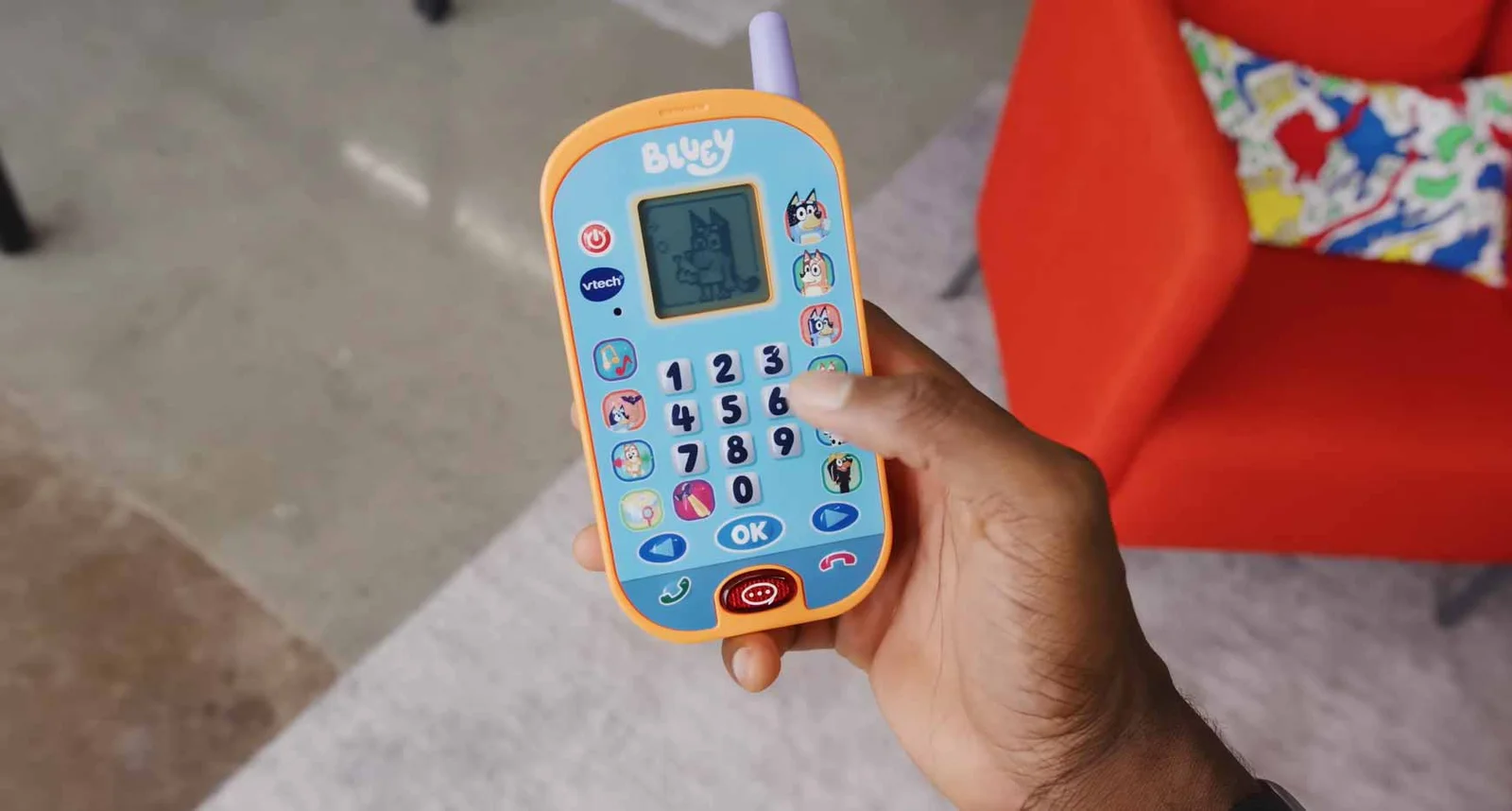
The Unboxing Experience and Industrial Design
The journey begins with an entirely disruptive packaging philosophy. Unlike the sleek, plastic-wrapped boxes of Silicon Valley flagships, the Bluey VTECH Phone arrives in an open-faced cardboard box. We found this approach refreshing, though the extraction process requires some manual labor. The device is secured with several fasteners that require a firm hand to untwist. While it lacks the premium “unfolding” sensation of a high-end foldable, it prioritizes sustainability and accessibility.

Notably, the box does not include a charger or a cable. However, in a move that feels like a nod to Right to Repair advocates, the phone features removable batteries. While you will need a small screwdriver—not included—to access the compartment, the ability to swap power cells on the fly is a feature we desperately miss in the broader market. Fortunately, our unit arrived with enough factory charge to boot up instantly, greeting us with a cheerful invitation to play.
Display Technology and Hardware Constraints
When we talk about the display, we aren’t discussing nits or color gamuts. The Bluey VTECH Phone utilizes a 1.7-inch monochrome screen. In a world of “AI slop” and visual overstimulation, this low-pixel-density panel is a sanctuary. It provides exactly the information you need and nothing more.
The hardware profile is substantial, reminiscent of the Nexus 6 era in terms of physical footprint, yet it remains light enough for comfortable extended use. We observed that the device features an integrated antenna, though it is important to note that there are no cellular radios or Wi-Fi modules present. This is a “zero-connectivity” device, making it the most secure phone on the market today. It is immune to hacking, data harvesting, and remote surveillance simply by virtue of its analog-first architecture.
Physical Interface and Tactile Feedback
One of the most striking features is the exclusively physical keyboard. In 2026, tactile feedback has been relegated to vibration motors, but the Bluey VTECH Phone offers real, mechanical buttons. When we entered digits, the device audibly announced the numbers. This auditory confirmation replaces the need for visual verification, allowing the user to remain present in their environment.
The rear-facing speaker is housed behind a generous grille. We tested the three-tier volume control and found that even at the highest setting, the audio remains clear without the distortion typically found in small-form-factor devices. The design ensures that you can never accidentally muffle the sound with your grip, showcasing a level of ergonomic consideration that many larger manufacturers overlook.
Redefining Mobile Software and “App” Utility
While other “minimalist” phones like the Light Phone or the Boox Palma still offer backdoors to the internet or basic apps, the Bluey VTECH Phone commits fully to its mission. We found the built-in software to be focused on active engagement rather than passive consumption.
- Zero-Click Games: There is no doom-scrolling here. Instead, we found a suite of games designed to trigger physical interaction.
- Microphone Interaction: One standout feature is a game that lets you blow into the microphone to create digital bubbles. This uses hardware sensors in a way that encourages respiratory focus—a “wellness” feature that isn’t hidden behind a subscription.
- The Chat Interface: There is a dedicated chat feature that bypasses the toxicity of social media. The “contacts” are limited to Bluey and Bingo. This creates a closed-loop social environment that is safe, predictable, and entirely local.
Performance Benchmarks and Battery Longevity
It is impossible to run traditional benchmarks on this device because it lacks a standard operating system or internet browser. However, in terms of cold boot speed, this is objectively one of the fastest phones we have ever tested. It transitions from “off” to “ready” in under two seconds.
The battery life is where this phone truly outclasses the competition. Because there is no background data syncing, GPS tracking, or high-brightness display, power consumption is negligible. We estimate the standby time in weeks, not days. This is the ultimate “emergency” device or secondary handset for those looking to disconnect for a weekend without worrying about a charging brick.
A Philosophical Shift in Mobile Computing
The Bluey VTECH Phone represents a necessary correction in the market. By having literally no cameras and no internet connection, the user is forced to engage with their surroundings. Screen time is naturally reduced from hours to mere minutes.
Comparing this to a $1,000 flagship is a fundamental category error. Those devices are built to capture your attention; this device is built to give it back to you. For the price of a coffee and a sandwich, VTECH has provided a tool that achieves what most “Digital Wellbeing” apps fail to do: it makes the internet impossible to reach.
Frequently Asked Questions (FAQ)
1. Does the Bluey VTECH Phone support 5G connectivity?
No, the device has no cellular radios and does not connect to any network, ensuring total privacy.
2. Can I install Instagram or TikTok on this phone?
Absolutely not. There is no internet connection and no app store, making it the perfect tool to combat doom-scrolling.
3. What kind of batteries does it use?
It uses standard AAA batteries, which can be replaced by opening the back panel with a tool.
4. Is there a headphone jack or Bluetooth?
There is no Bluetooth or 3.5mm jack. All audio is handled via the high-output rear speaker.
5. How big is the screen? It features a 1.7-inch black-and-white display designed for high visibility and low power consumption.
6. Does it have a camera for video calls?
No, this phone has zero cameras, eliminating any concerns about digital privacy or lens flare.
7. Who is the primary audience for this device?
While designed as a toy, it is increasingly popular among minimalists and those seeking a total digital detox.
8. Is the phone water-resistant?
The hardware is robust, but it does not carry an official IP rating. We recommend keeping it away from heavy moisture.
9. Can I text other people with the chat feature?
The chat feature is a local simulation involving the characters Bluey and Bingo; it does not send external messages.
10. Why is the unboxing experience different?
The open-faced cardboard is designed for immediate visibility on retail shelves and reduces the use of excess plastic.
Final Verdict: Is the Bluey Phone for You?
We must conclude that for a specific subset of the population, the Bluey VTECH Phone is a masterclass in subtractive design. It is a device that does very little, and it does that “little” with absolute confidence. If you are tired of the constant pings, the algorithmic feeds, and the pressure of the 2026 digital landscape, this might be the most important piece of tech you buy this year.

Selva Ganesh is a Computer Science Engineer, Android Developer, and Tech Enthusiast. As the Chief Editor of this blog, he brings over 10 years of experience in Android development and professional blogging. He has completed multiple courses under the Google News Initiative, enhancing his expertise in digital journalism and content accuracy. Selva also manages Android Infotech, a globally recognized platform known for its practical, solution-focused articles that help users resolve Android-related issues.





Leave a Reply