
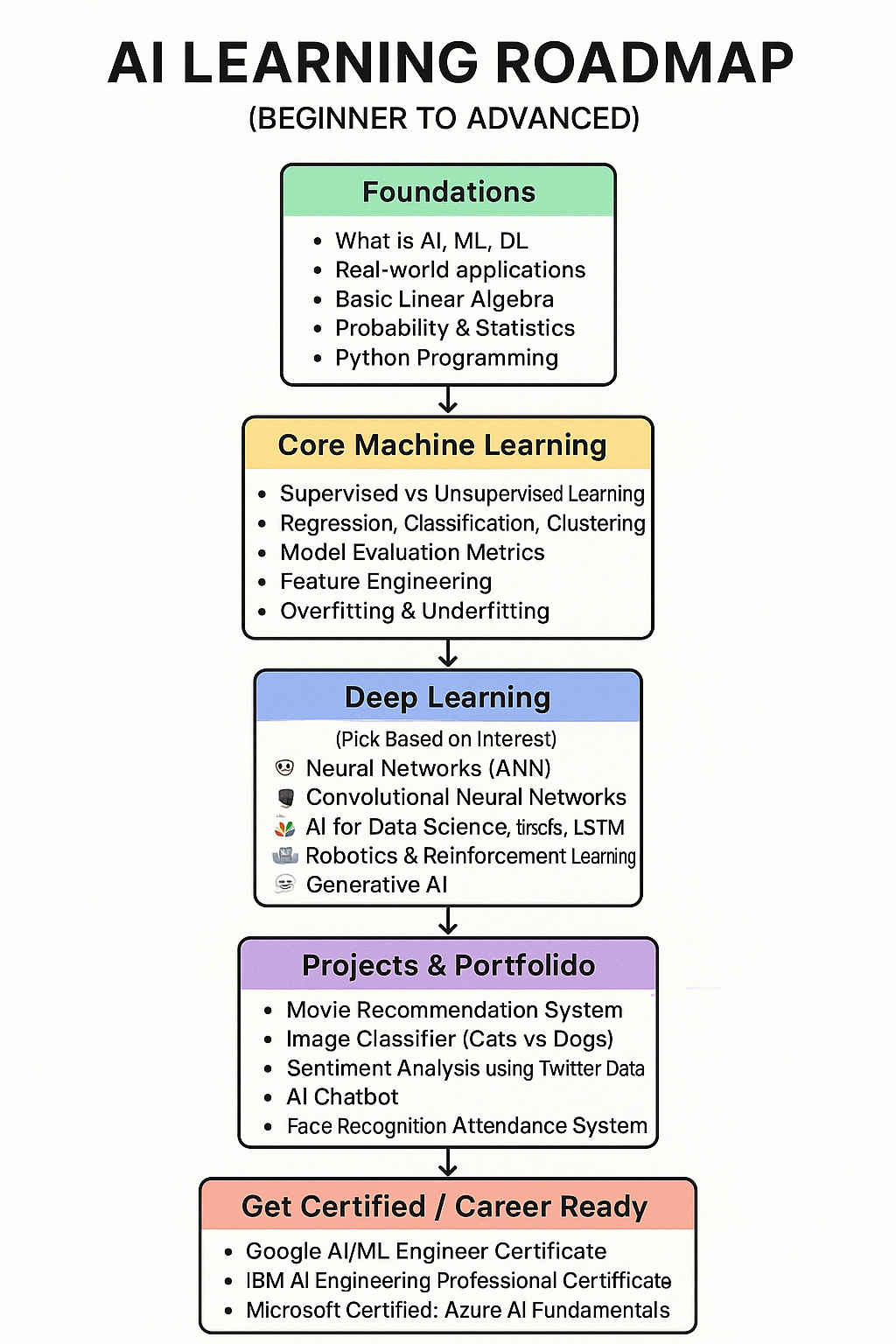
Artificial Intelligence is reshaping industries globally. Whether you aim to become an AI Engineer, Data Scientist, or AI Product Manager, a structured and practical roadmap is essential. This comprehensive AI learning roadmap will guide you from absolute beginner to advanced proficiency, without needing a prior coding background.
Stage 1: Foundations – No Coding Background Needed
Understanding the foundational concepts of AI is the first crucial step. This stage emphasizes mathematical intuition, logical thinking, and basic programming.
Essential Topics to Master
- What is AI?
- Explore the fundamentals of Artificial Intelligence, its history, and its impact on society.
- Difference Between AI, Machine Learning (ML), and Deep Learning (DL)
- Clarify the relationship between these closely linked domains.
- Real-World Applications of AI
- From chatbots to autonomous cars, discover where AI is used today.
- Basic Linear Algebra
- Learn vectors, matrices, and the dot product — the math powering AI algorithms.
- Probability & Statistics
- Grasp key concepts like mean, variance, standard deviation, probability distributions, and Bayes’ Theorem.
- Introduction to Python Programming
- Python is the most widely used language in AI. Learn syntax, variables, loops, functions, and libraries.
️ Tools & Platforms
- Khan Academy – For Math fundamentals
- W3Schools / Codecademy – Beginner-friendly Python tutorials
- Google Colab – Free, browser-based Python execution environment
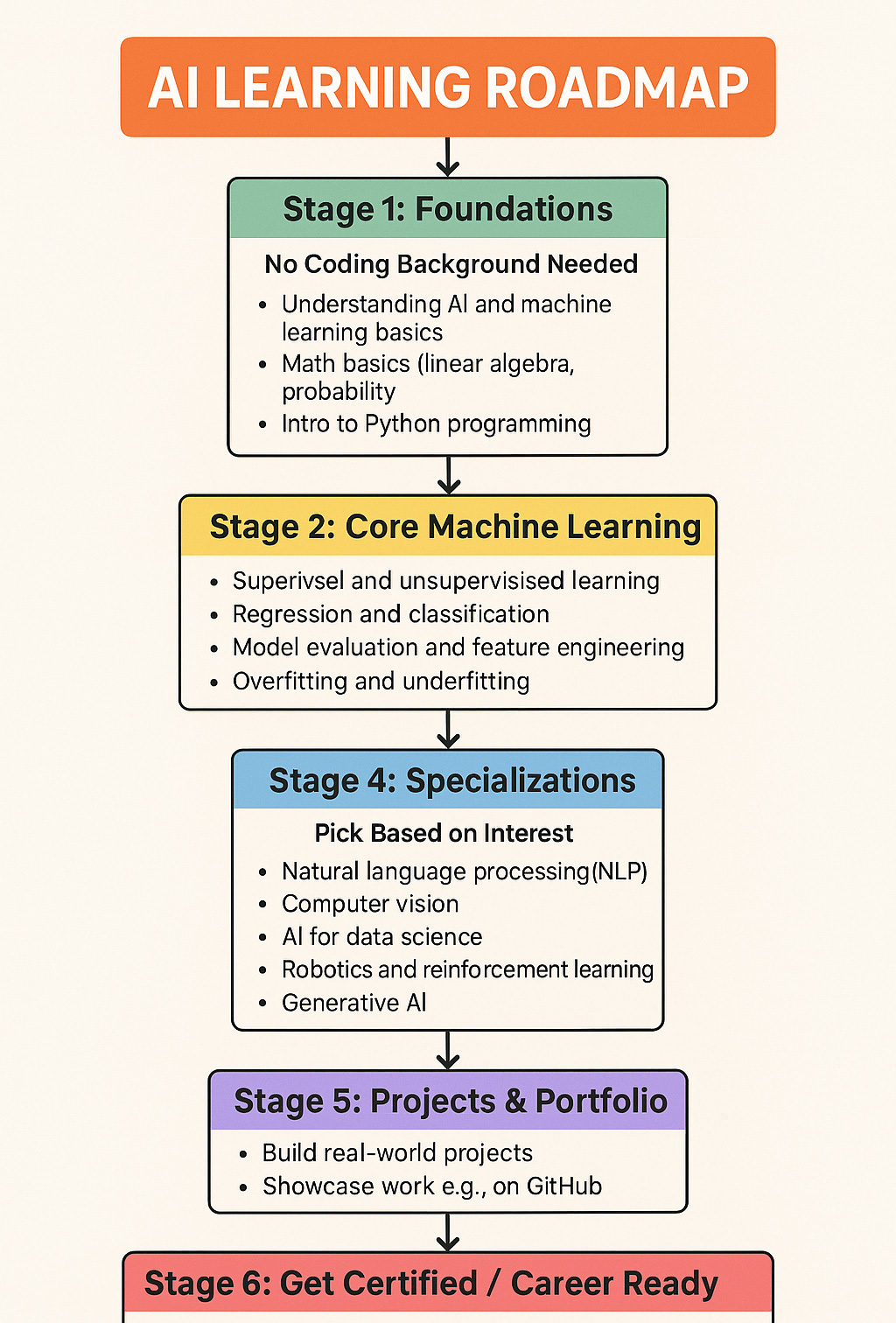

Stage 2: Core Machine Learning
Once the basics are solid, dive into the core machine learning concepts that form the backbone of intelligent systems.
Key Topics to Focus On
- Supervised vs Unsupervised Learning
- Understand labeled vs unlabeled data problems.
- Regression & Classification
- Learn linear regression, logistic regression, decision trees, and support vector machines.
- Clustering Techniques
- Explore K-means, DBSCAN, and hierarchical clustering.
- Model Evaluation Metrics
- Master metrics like accuracy, precision, recall, F1-score, and ROC-AUC to assess performance.
- Overfitting & Underfitting
- Recognize and handle model generalization issues.
- Feature Engineering
- Learn how to extract, select, and transform raw data into suitable input for ML models.
Top Courses
- Andrew Ng’s Machine Learning Course – Coursera
- Google’s Machine Learning Crash Course
️ Tools for Practical Learning
- Python – Programming Language
- Jupyter Notebook – Interactive environment for coding
- Scikit-learn – Popular ML library
- NumPy & Pandas – For numerical and data analysis
Stage 3: Deep Learning
This stage takes you deeper into how neural networks learn complex patterns from data. Deep Learning is the key to modern Computer Vision, NLP, and Robotics breakthroughs.
Core Deep Learning Concepts
- Artificial Neural Networks (ANNs)
- Understand perceptrons, weights, biases, and activation functions.
- Convolutional Neural Networks (CNNs)
- Designed for image classification and object detection.
- Recurrent Neural Networks (RNNs) and LSTM
- Ideal for time-series data, sequences, and natural language.
- Activation Functions
- Explore ReLU, Sigmoid, Tanh.
- Optimizers & Loss Functions
- Learn about SGD, Adam, cross-entropy, and mean squared error.
Best Learning Resources
- Deep Learning Specialization by Andrew Ng – Coursera
- Fast.ai Practical Deep Learning for Coders
️ Must-Know Tools
- TensorFlow
- Keras
- PyTorch
Stage 4: Specializations – Choose Your Niche
Once you grasp deep Learning, specialize based on your interests and career goals.
Natural Language Processing (NLP)
- Text Preprocessing, Tokenization
- Transformers, BERT, GPT, ChatGPT
- Chatbots, Text Generation
️ Computer Vision
- Object Detection, Image Classification
- YOLO, OpenCV, Transfer Learning
AI for Data Science
- Time Series Forecasting
- Predictive Modeling
- Data Cleaning & Preprocessing
Robotics & Reinforcement Learning
- Q-Learning, Policy Gradient Methods
- OpenAI Gym for RL environments
Generative AI (Hot in 2025!)
- Large Language Models (LLMs)
- Diffusion Models (e.g., Stable Diffusion)
- AI-generated Art, Voice Cloning, Music Generation
Stage 5: Real-World Projects & Portfolio
Now it’s time to apply and demonstrate your knowledge through real-world projects.
Project Ideas
- AI Chatbot using NLP and Deep Learning
- Movie Recommendation System with Collaborative Filtering
- Cats vs Dogs Image Classifier using CNN
- Sentiment Analysis on Twitter Data
- Face Recognition Attendance System
Platforms to Showcase Your Work
- GitHub – Host and version your code
- Kaggle – Compete in challenges, use rich datasets
- Medium / LinkedIn – Document and share your journey
Stage 6: Get Certified and Career-Ready
Solidify your credentials with globally recognized certifications and start applying for AI jobs.
Recommended Certifications
- Google Professional Machine Learning Engineer
- IBM AI Engineering Professional Certificate
- Microsoft Azure AI Fundamentals
In-Demand Job Roles
- Machine Learning Engineer
- Data Scientist
- AI Research Scientist
- NLP Engineer
- Computer Vision Engineer
- AI Product Manager
Bonus Tips for Staying Ahead
- Stay Updated
- Subscribe to Towards Data Science, Analytics Vidhya, and DeepLearning.ai newsletters.
- Read Research Papers
- Use arXiv.org to explore cutting-edge AI innovations.
- Daily Practice
- Solve ML problems on Kaggle, LeetCode, and contribute on GitHub.
- Network & Collaborate
- Join communities on Reddit (r/MachineLearning), Discord AI groups, and AI Slack communities.
Wrap Up
Following this structured roadmap, you can transform from an AI novice to an industry-ready expert. From basic math and Python, through machine learning, to deep specializations and real-world projects, this path empowers anyone to master AI in 2025 and beyond.

Selva Ganesh is a Computer Science Engineer, Android Developer, and Tech Enthusiast. As the Chief Editor of this blog, he brings over 10 years of experience in Android development and professional blogging. He has completed multiple courses under the Google News Initiative, enhancing his expertise in digital journalism and content accuracy. Selva also manages Android Infotech, a globally recognized platform known for its practical, solution-focused articles that help users resolve Android-related issues.




Helpful resources for math if you’re rusty.
Clear guidance on tooling per role.
Includes system design considerations for AI services.
The PM track advice is practical and detailed.
The checkpoints at each stage make progress measurable.
Helped me plan a 12-week study schedule.
Great sequence: data → model → deploy → monitor.
Practical notes on GPUs, notebooks, and costs.
The roadmap’s resource curation is top-notch.
Solid structure for career switchers.
Love the weekly sprints concept to avoid burnout.
The LLM evaluation metrics section is very useful.
Concise and current—feels aligned to 2025 hiring.
The checkpoints for math make it less intimidating.
Highlighting data versioning early is a pro move.
This made choosing cloud vs local training much clearer.
The RL and CV mentions are short and to the point.
Simple path from Numpy/Pandas to full ML pipelines.
Clear advice on when to fine-tune vs use RAG.
The portfolio-building tips are hiring-friendly.