
The technological landscape shifted profoundly this week at Microsoft Build 2026. As we navigate the rapidly evolving era of agentic AI and cloud-native infrastructure, Microsoft has signaled a clear intent to move beyond general-purpose large language models. The announcements focused on deep integration, localized AI compute, and specialized hardware designed to sustain the next generation of autonomous workloads. We are witnessing the maturation of the developer ecosystem, transitioning from simple code assistance to complex, agent-led infrastructure management.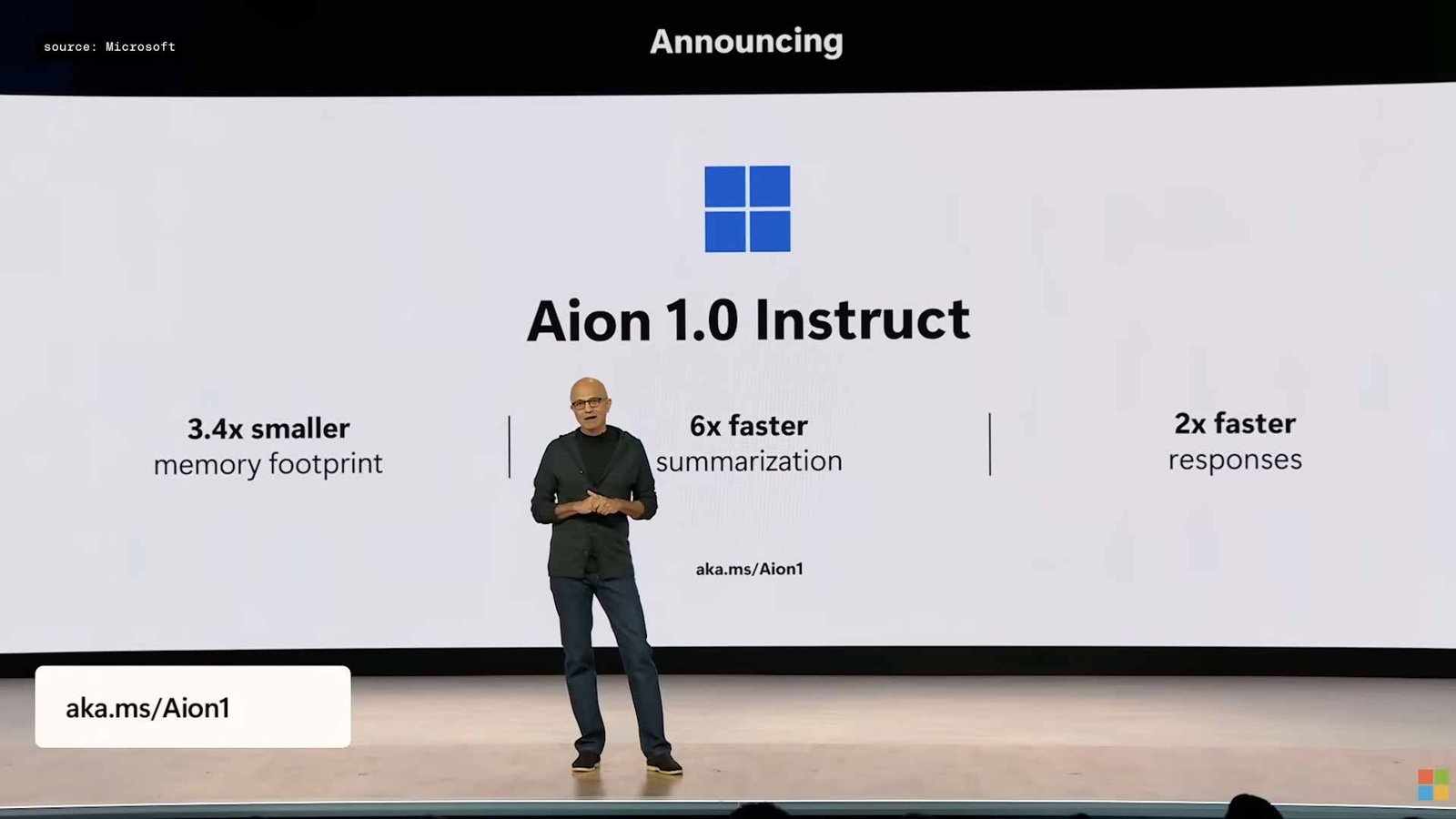
1. The Era of Agentic Loops with Aion 1.0
The most significant shift we observed was the introduction of Aion 1.0, a dual-faceted model architecture comprising Instruct and Plan variants. Unlike previous iterative models, Aion is purpose-built for local agentic loops. This allows developers to maintain privacy and reduce latency by executing complex logic directly on the machine. By offloading decision-making processes to a local environment, we can now build applications that autonomously resolve tasks without constant round-trips to the cloud. This is a monumental step forward for local AI deployment, ensuring that personal and enterprise data remains isolated within secure boundaries while maximizing the utility of available on-device compute.

2. Revolutionizing Development Environments
Microsoft has overhauled the core developer experience with a suite of tools that fundamentally alter how we interact with the operating system. The new Intelligent Terminal now features deep GitHub Copilot integration, transforming the command line into an interactive coding partner. Furthermore, the introduction of a Git-aware File Explorer enables developers to track versioning and branching status without leaving their primary file navigation interface. Perhaps most exciting is the inclusion of native WSL container support, which streamlines the bridge between local development and production-ready environments. These tools suggest that Microsoft is prioritizing developer productivity and minimizing context-switching as the primary goal for the coming year.
3. High-Performance Hardware for AI Agents
For years, we have struggled with the limitations of off-the-shelf hardware when training and deploying resource-heavy AI agents. The debut of the Surface RTX Spark Dev Box changes the calculus entirely. Featuring an ARM-based Nvidia SOC, this machine packs 128GB of unified memory and an impressive 1 teraflop of AI compute into a single chassis. Simultaneously, Project Solara offers a versatile platform for deploying these agents across unconventional form factors—ranging from digital badges to desk-bound devices. This hardware-software synergy ensures that we are no longer tethered to massive server clusters for high-performance agentic execution.
4. Azure Infrastructure and Data Scaling
Scaling AI workloads requires more than just raw processing power; it requires architectural excellence. Microsoft’s announcement of the Maia 200 AI accelerator is designed explicitly to bolster Azure capacity, providing the necessary throughput for massive, multi-tenant agentic networks. Complementing this, the Cobalt 200 VMs deliver specialized performance specifically tuned for agentic workload management. For database administrators, Azure Horizon DB represents a paradigm shift. This fully managed PostgreSQL service optimizes transactional integrity while integrating seamlessly with the high-speed requirements of modern AI models.
5. Security and Frontier Model Evolution
We cannot discuss progress without addressing security and the underlying intelligence of the systems. The launch of Microsoft Execution Containers (MXC) provides OS-level isolation, ensuring that even in an agent-driven world, core system integrity remains uncompromised. To manage this complexity, the GitHub Copilot app now offers dedicated management for agentic coding sessions. Furthermore, the expansion of the MAI model family, specifically MAI Thinking One and MAI Code One Flash, demonstrates a commitment to specialized reasoning and high-speed coding tasks. Additionally, the partnership with the Mayo Clinic on a health-focused frontier model and the breakthrough in quantum computing with Majorana 2—which offers unprecedented cubit lifetimes—hint at the immense future potential of these research investments.
Frequently Asked Questions
What is the core purpose of the Aion 1.0 models?
Aion 1.0 is designed for local agentic loops, allowing developers to execute complex AI logic locally for better privacy and lower latency.
How does the Surface RTX Spark Dev Box improve development?
It provides 128GB of unified memory and 1 teraflop of AI compute in an Arm-based Nvidia SOC, specifically for heavy AI agent testing.
What is Project Solara?
Project Solara is a hardware/software platform that enables AI agents to run on diverse form factors like digital badges and smart desk devices.
How does the Intelligent Terminal differ from a standard terminal?
It includes integrated GitHub Copilot, allowing for real-time coding assistance and context-aware suggestions directly in the CLI.
What are the benefits of Microsoft Execution Containers (MXC)?
MXC provides OS-level isolation, ensuring secure execution environments for autonomous agents.
What does Azure Horizon DB provide?
It is a fully managed PostgreSQL service optimized for the scaling and performance needs of modern, AI-integrated enterprise applications.
What is MAI thinking of, and MAI Code One Flash?
These are new members of the MAI model family specialized for advanced reasoning and high-speed coding development.
What is the significance of the Majorana 2 breakthrough?
It represents a leap in quantum computing by achieving significantly longer cubit lifetimes, moving us closer to practical quantum advantage.
Who is the primary target for the new GitHub Copilot app features?
The app is designed for developers who need to manage and oversee complex agentic coding sessions effectively.
Does the new Git-aware File Explorer support all repositories?
Yes, it is designed to recognize and track Git branches and status natively within the Windows File Explorer interface.

Selva Ganesh is a Computer Science Engineer, Android Developer, and Tech Enthusiast. As the Chief Editor of this blog, he brings over 10 years of experience in Android development and professional blogging. He has completed multiple courses under the Google News Initiative, enhancing his expertise in digital journalism and content accuracy. Selva also manages Android Infotech, a globally recognized platform known for its practical, solution-focused articles that help users resolve Android-related issues.




Leave a Reply