
OLED iPad Air 2027: Expected Release Date, Specs, Features & Latest News – Apple continues to transform its popular tablet lineup by bringing advanced display upgrades to everyday users. Following the introduction of organic light-emitting diode displays—commonly known as OLED—to the top-tier iPad Pro and the compact iPad mini, industry reports indicate that the mid-range iPad Air is next in line.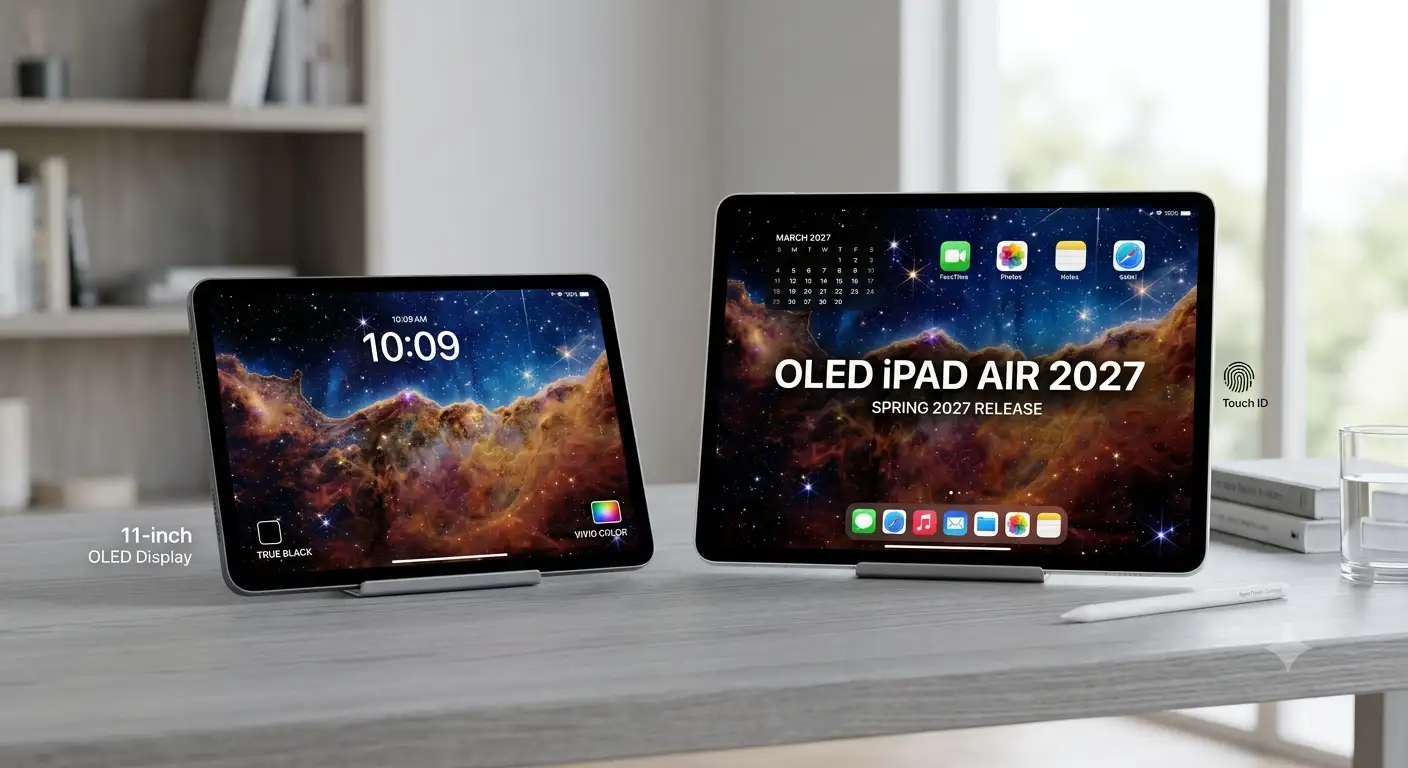
For everyday consumers, students, and professionals who want a vivid screen without paying top-tier prices, this upcoming release marks a significant milestone. In this article, we explore the expected arrival date, display enhancements, core features, and key differences you should expect from the next-generation iPad Air.

Expected Release Date: When Will the OLED iPad Air Arrive?
Industry supply chain reports suggest that the OLED iPad Air is slated to debut in early 2027, most likely during Apple’s traditional spring launch window between March and April.
Apple refreshed the iPad Air lineup earlier with internal processor updates. However, display manufacturing schedules require significant preparation time. Display panel production is expected to begin toward the end of 2026, setting the stage for a rollout in the first half of 2027.
Apple typically reserves its spring announcements for mainstream hardware updates, making a March 2027 or April 2027 announcement highly probable.
What Is OLED Display Technology and Why Does It Matter?
If you are unfamiliar with display terminology, comparing traditional screens with OLED panels helps explain why this update is so important.
Current iPad Air models utilize Liquid Crystal Displays, known as LCD screens. These screens rely on a big backlight behind the panel to illuminate every pixel. While LCDs offer bright and reliable visuals, they struggle to produce true black tones because the backlight stays turned on even when showing dark scenes.
An OLED screen, by contrast, uses self-illuminating pixels. Every single pixel controls its own light and can turn completely off. This design yields several distinct real-world benefits:
-
True Blacks and Infinite Contrast: Dark scenes in movies or photo editing look deep and realistic rather than grayish.
-
Vibrant and Accurate Colors: Images look richer and more vibrant, making streaming videos and browsing artwork far more immersive.
-
Thinner and Lighter Builds: Eliminating heavy backlight layers allows Apple to craft thinner, more lightweight tablet bodies.
-
Improved Power Efficiency: Displaying darker content consumes less battery because individual pixels do not require power when black.
Screen Sizes: Options for Every Need
According to supply chain details, Apple plans to offer the new OLED iPad Air in two distinct screen sizes:
-
11-Inch Model: The ideal portable balance for students, travelers, and everyday users who prefer a compact footprint.
-
13-Inch Model: A roomier canvas tailored for digital artists, multitaskers, and users replacing a traditional laptop.
Providing two sizes gives consumers flexibility to choose between lightweight portability and maximum screen workspace.
Key Hardware Specs and Expected Features
While the screen technology receives a major overhaul, Apple is expected to balance premium upgrades with cost-saving choices to keep the iPad Air affordable.
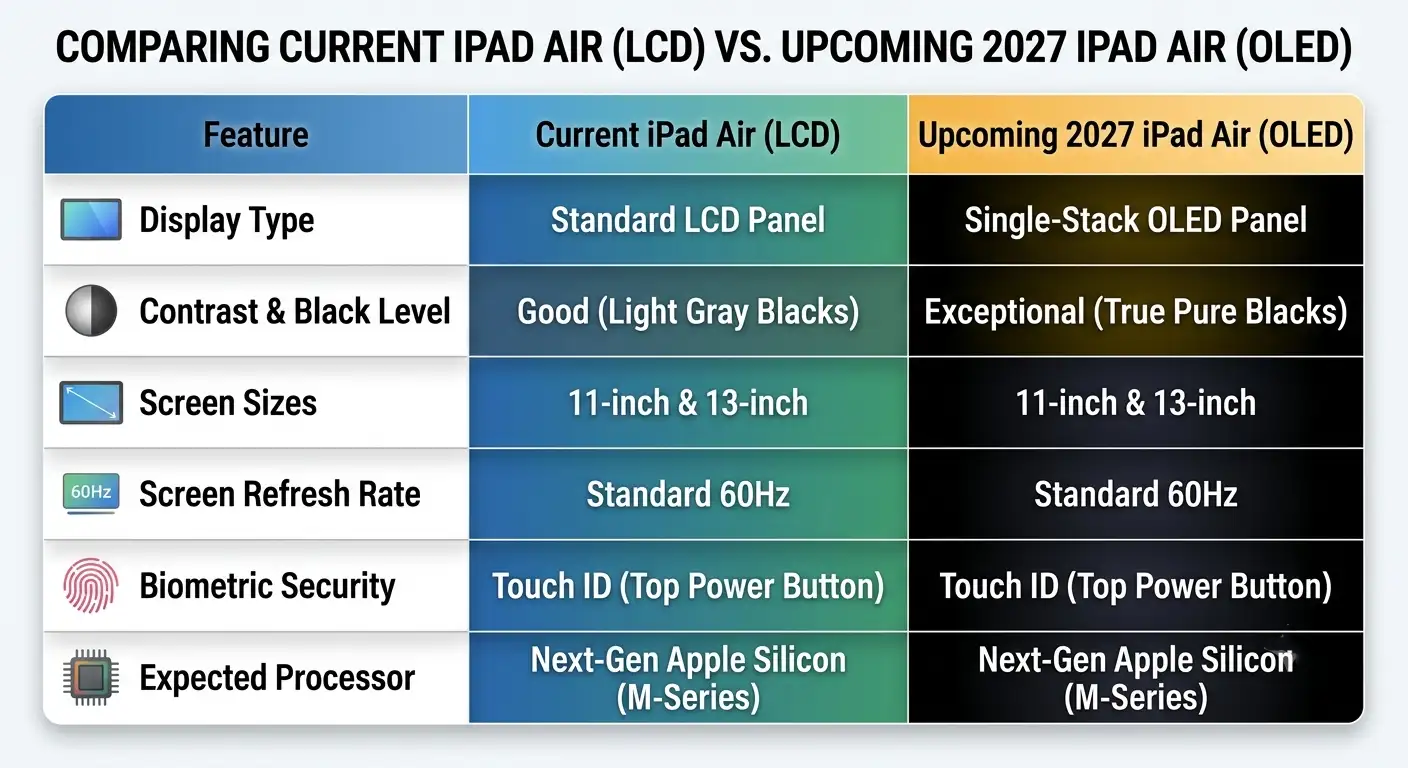
Standard 60Hz Screen Refresh Rate
To keep the device reasonably priced, reports confirm that the OLED iPad Air will retain a standard 60Hz refresh rate. Premium features like Apple’s ProMotion tech—which offers ultra-smooth 120Hz scrolling—will remain exclusive to the higher-end iPad Pro lineup. For average users browsing websites, reading ebooks, or watching videos, a 60Hz OLED screen delivers a crisp and satisfying visual experience.
Biometric Security: Keeping Touch ID
Unlike the premium iPad Pro which features Face ID facial recognition, the OLED iPad Air is expected to retain the reliable Touch ID sensor built directly into the top power button. This approach keeps production costs down while maintaining quick and familiar fingerprint unlock capability.
Next-Generation Performance
Inside the chassis, the tablet will feature Apple’s latest custom M-series processors, ensuring speedy multitasking, quick app launches, and strong performance for gaming, video playback, and everyday work tasks.
How the iPad Air OLED Differs From the iPad Pro
Understanding where the iPad Air sits in Apple’s tablet family helps buyers make informed purchasing decisions:
-
Single-Layer OLED Structure: The iPad Air is set to adopt a single-layer OLED screen. In comparison, the iPad Pro features a dual-layer “tandem OLED” panel that achieves extreme brightness levels for heavy professional editing work.
-
Screen Smoothness: The iPad Pro dynamically adjusts screen refresh speeds up to 120Hz for fluid scrolling and stylus drawing. The iPad Air maintains a standard 60Hz refresh rate.
-
Price Accessibility: By omitting secondary backlights, complex sensor setups, and high-refresh panels, Apple keeps the Air tier significantly more budget-friendly than Pro models.
For non-technical buyers, these choices mean you get the visual richness of an OLED television in a tablet without paying for niche features designed for high-end video editors.
Supply Chain Partners and Production Expectations
Major electronics manufacturers are preparing for large-scale production runs. Reports highlight Samsung Display as the primary panel supplier for the upcoming tablet, with additional manufacturing support from display supplier BOE.
Industry projections estimate shipping volumes between 4 million and 5 million units in 2027 across both 11-inch and 13-inch sizes. This substantial volume underscores Apple’s confidence in strong consumer demand for a mid-tier OLED tablet.
Should You Wait or Buy Now?
Choosing whether to buy a tablet today or wait for the 2027 refresh depends entirely on your current needs:
-
Buy Now If: You need a tablet immediately for school, work, or leisure. Current LCD iPad Air models already offer excellent performance, crisp displays, and great battery life for daily tasks.
-
Wait for 2027 If: Your primary uses are watching movies, editing photos, or consuming digital media, and you want rich colors, deep blacks, and a thinner design without paying high-end Pro prices.
Frequently Asked Questions
1. When is the OLED iPad Air expected to be released?
Industry reports indicate that Apple is planning to launch the OLED iPad Air in early 2027, likely during a spring announcement event around March or April.
2. What makes an OLED display better than an LCD display?
OLED screens use self-lit pixels that turn off completely to display true blacks, offering superior color contrast, deeper dark scenes, lighter screen designs, and improved energy efficiency compared to LCDs.
3. Will the new iPad Air come in two screen sizes?
Yes, Apple is expected to offer the OLED iPad Air in both 11-inch and 13-inch options, providing choices for both high portability and larger screen real estate.
4. Will the OLED iPad Air have Face ID?
No, current leaks indicate that Apple will retain the traditional Touch ID sensor integrated into the top power button to keep hardware costs manageable.
5. Does the OLED iPad Air support a 120Hz refresh rate?
No, the OLED iPad Air is expected to feature a standard 60Hz refresh rate, leaving the high-refresh 120Hz ProMotion display exclusive to the more expensive iPad Pro series.
6. Is the screen on the iPad Air identical to the iPad Pro screen?
No, the iPad Air will use a simplified single-layer OLED panel. The iPad Pro uses a dual-layer tandem OLED screen that delivers higher maximum brightness levels for professional work.
7. How much will the OLED iPad Air cost?
While official pricing has not been announced, Apple typically aims to keep the iPad Air tier competitive, positioning it between the base iPad model and the higher-priced iPad Pro.
8. Who is manufacturing the OLED panels for the new iPad Air?
Primary screen supply will be handled by Samsung Display, with additional supply support expected from BOE.
9. Will the battery life improve with an OLED screen?
Because OLED pixels turn off completely when displaying black elements, dark mode and dark video scenes use less power, contributing to better overall battery efficiency.
10. Should I wait for the 2027 iPad Air or buy a current model?
If you want deep black levels, vibrant movie playback, and a thinner tablet build at a mid-tier price, waiting for 2027 is a solid option. If you need a capable tablet right away, current models remain great daily performers.

Selva Ganesh is a Computer Science Engineer, Android Developer, and Tech Enthusiast. As the Chief Editor of this blog, he brings over 10 years of experience in Android development and professional blogging. He has completed multiple courses under the Google News Initiative, enhancing his expertise in digital journalism and content accuracy. Selva also manages Android Infotech, a globally recognized platform known for its practical, solution-focused articles that help users resolve Android-related issues.




Leave a Reply