
Google WeatherNext 2 AI Explained – Weather forecasting is undergoing a fundamental transformation, driven by breakthrough developments in artificial intelligence from Google DeepMind and Google Research. With the introduction of WeatherNext 2, we are witnessing a massive paradigm shift in how meteorologists, industries, and everyday individuals predict, prepare for, and respond to atmospheric shifts across the globe.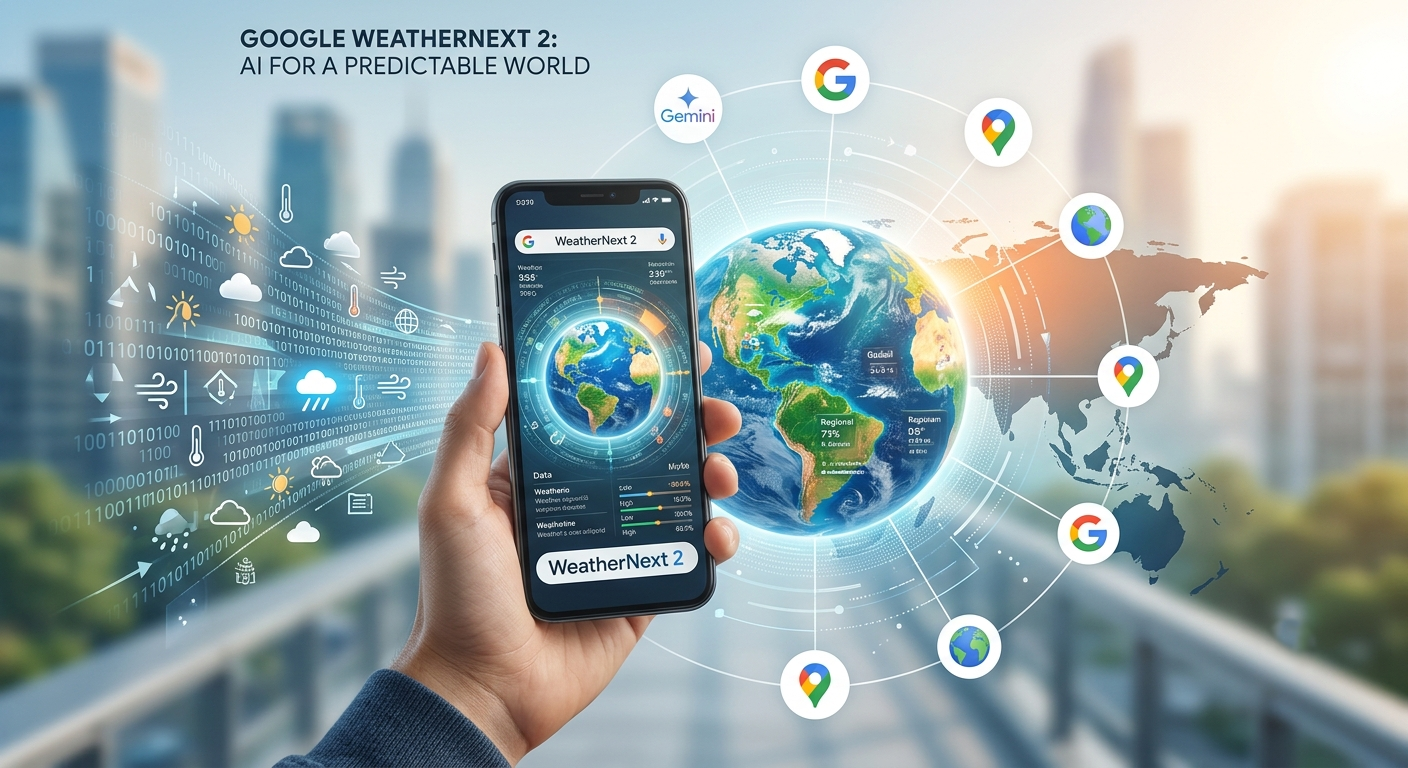
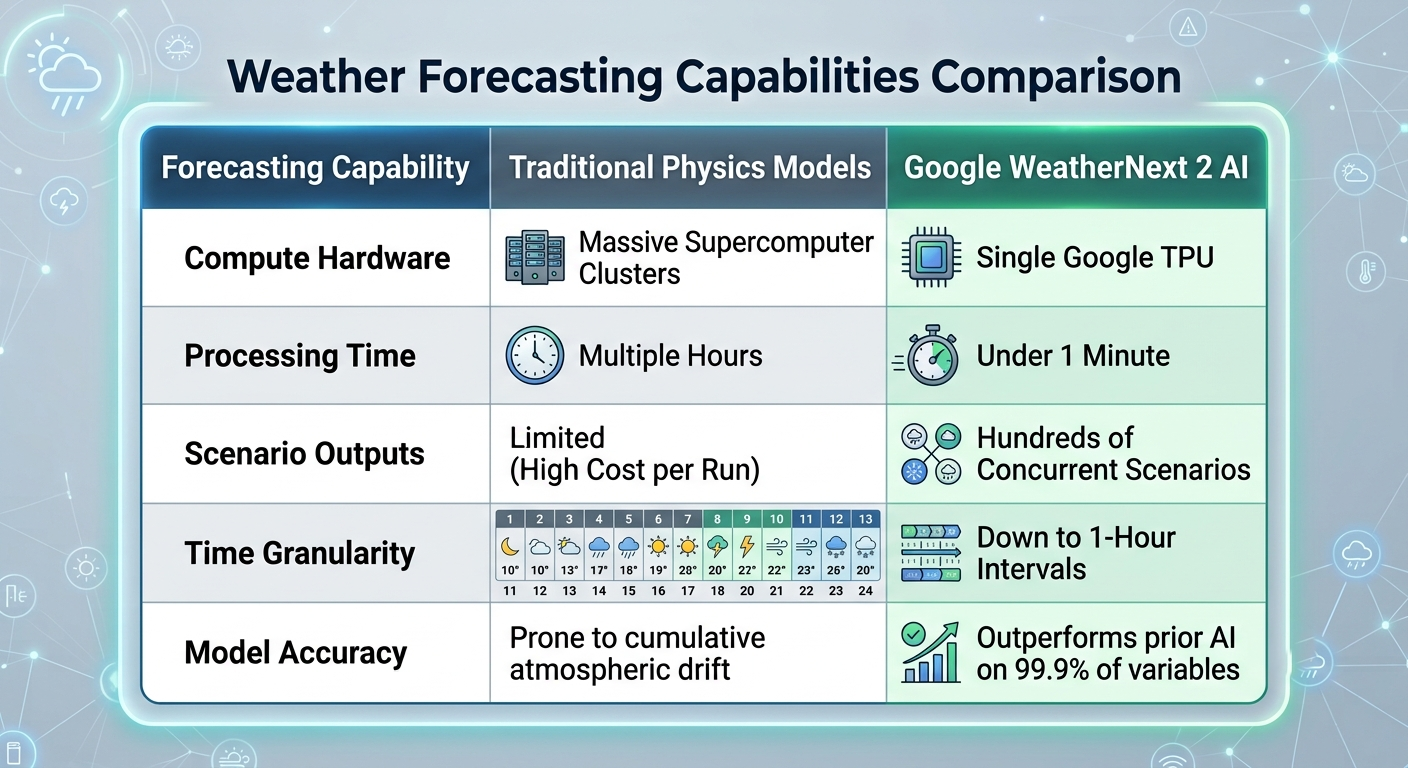
Traditional weather prediction models have long relied on heavy supercomputing power running complex mathematical equations based on physics. While effective, these older systems are notoriously slow, expensive to operate, and limited in their ability to simulate multiple potential weather scenarios rapidly. Google WeatherNext 2 directly addresses these limitations by utilizing advanced machine learning techniques to generate hyper-accurate, high-resolution global atmospheric predictions 8 times faster than previous iterations.

In this comprehensive guide, we break down what WeatherNext 2 is, how it works in simple terms, why it outpaces traditional atmospheric models, and how its integration across everyday consumer products like Google Search, Gemini, Pixel Weather, and Google Maps impacts everyday life.
What Is Google WeatherNext 2?
WeatherNext 2 represents Google DeepMind’s most advanced artificial intelligence model designed specifically for global weather forecasting. Built upon years of cutting-edge meteorological research, WeatherNext 2 takes raw planetary data—such as air pressure, temperature, wind speed, and atmospheric humidity—and processes it through neural networks to project future weather conditions up to 15 days in advance.
What sets WeatherNext 2 apart from conventional weather software is its combination of unrivaled speed, hyper-granular resolution, and probabilistic ensemble forecasting. Rather than producing a single static prediction, WeatherNext 2 can calculate hundreds of distinct, plausible weather scenarios in under one minute on a single Tensor Processing Unit (TPU). To put that into perspective, generating similar multi-scenario outputs using traditional physics-based models requires massive supercomputing clusters running for hours.
Key Milestones and Performance Upgrades
-
Surpasses Previous Models: WeatherNext 2 outperforms the original WeatherNext baseline across 99.9% of evaluated atmospheric variables (including temperature, wind velocity, and moisture levels) and lead times ranging from 0 to 15 days.
-
Higher Temporal Resolution: Projections are available at hourly increments, offering unparalleled granularity for local planning.
-
8x Faster Generation Speed: Forecast outputs are delivered in seconds, enabling real-time emergency adjustments during extreme weather events like tropical cyclones or rapid heatwaves.
How WeatherNext 2 Works: A Simple Explanation
To understand WeatherNext 2 without drowning in technical jargon, imagine trying to predict where a single drop of ink will spread in a glass of turbulent water.
A traditional physics model attempts to measure every single molecule of water and use massive equations to calculate the exact motion of the ink. It takes immense computational effort, and if even one small measurement is slightly off, the entire calculation fails—a phenomenon known in science as the butterfly effect.
Instead of calculating every physical force from scratch, WeatherNext 2 acts like a master pattern recognition system. Having studied decades of historical global weather patterns, it instantly recognizes how atmospheric elements interact. When given today’s weather conditions, the AI quickly determines what tomorrow will look like based on billions of historical data points.
The Secret Sauce: Functional Generative Networks (FGN)
At the heart of WeatherNext 2 is a novel AI modeling technique called a Functional Generative Network (FGN).
When predicting the future, it is critical to know not just the most likely weather, but also the worst-case scenarios. To achieve this, WeatherNext 2 intentionally injects controlled “mathematical noise” into its model architecture. This allows the AI to output hundreds of slightly different, realistic weather forecasts simultaneously.
-
Marginal Forecasts (Individual Details): The AI learns specific local elements thoroughly—such as exact temperature at a single zip code or wind speed at a specific altitude.
-
Joint Forecasts (Interconnected Systems): Because all physical elements in nature are linked, the model automatically connects these individual details into realistic, large-scale systems. This ensures that when predicting a heatwave across an entire continent, the surrounding wind patterns, humidity levels, and cloud coverage remain physically consistent and logical.
Why Probabilistic Forecasting Matters for Real-World Decisions
For decades, standard weather reports gave a single number: “Tomorrow will be 72°F with a 20% chance of rain.” However, critical global decisions—ranging from airline trajectory planning to disaster response management—cannot rely on simplified single-point estimates. They require knowing the full spectrum of possibilities.
By calculating hundreds of variations in less than 60 seconds, WeatherNext 2 delivers powerful ensemble forecasts. This enables decision-makers to evaluate extreme risk factors long before severe conditions materialize.
Practical Applications: How WeatherNext 2 Impacts Everyday Life
The technological advancements inside WeatherNext 2 extend far beyond scientific laboratories. Google is actively deploying this technology directly into enterprise infrastructure and everyday consumer applications.
1. Consumer Upgrades in Google Apps
WeatherNext 2 is now actively powering weather insights across Google’s broader software ecosystem:
-
Google Search & Gemini: Get instant, hyper-local weather summaries and natural language explanations of upcoming atmospheric shifts.
-
Pixel Weather App: Offers Pixel device users remarkably accurate hourly breakdowns for precipitation and temperature changes.
-
Google Maps & Maps API: Upgrades navigational routing by predicting weather conditions along driving routes in real time, helping drivers avoid sudden storms or freezing roads.
2. Commercial and Enterprise Integrations
Through Google Cloud, businesses and researchers can leverage raw WeatherNext 2 data streams for strategic planning:
-
Google Earth Engine & BigQuery: Developers and spatial analysts can directly query massive global forecast datasets alongside historical geographical layers.
-
Vertex AI Early Access Program: Enterprise businesses can host custom AI inferences using WeatherNext 2 as a foundation model to predict renewable energy output (such as wind farm yield) or optimize supply chain logistics around tropical storm trajectories.
The Future of AI in Earth Sciences
The launch of WeatherNext 2 marks a major step forward in computational climate science. By combining deep learning with atmospheric physics, Google DeepMind and Google Research have demonstrated that artificial intelligence can deliver higher resolution, greater speed, and deeper probabilistic insight than traditional supercomputing alone.
As global climate conditions become increasingly volatile, having access to rapid, high-resolution forecasting tools is no longer just a technical luxury—it is a vital pillar for global safety, agricultural planning, renewable energy optimization, and disaster mitigation. WeatherNext 2 sets a new standard for how humanity monitors and anticipates the atmosphere around us.

Selva Ganesh is a Computer Science Engineer, Android Developer, and Tech Enthusiast. As the Chief Editor of this blog, he brings over 10 years of experience in Android development and professional blogging. He has completed multiple courses under the Google News Initiative, enhancing his expertise in digital journalism and content accuracy. Selva also manages Android Infotech, a globally recognized platform known for its practical, solution-focused articles that help users resolve Android-related issues.





Leave a Reply