
Integrating enterprise artificial intelligence requires absolute precision when targeting model architectures. When we build scalable software systems, selecting the appropriate Google Gemini API shortcodes and endpoints determines computational efficiency, operational latency, cost management, and system resilience. This technical manual documents our hands-on architectural journey, practical benchmarks, and complete endpoint mappings across the entire Google Gemini ecosystem.

Architectural Evolution of Google Gemini Engine Generations
Through our engineering iterations across distributed microservices, we observed distinct phase transitions across Gemini releases. The platform has shifted from basic text comprehension to native, deeply integrated multimodal processing pipelines capable of executing high-throughput real-time tasks.
The Gemini 3 Series Paradigm
The Gemini 3 architecture introduces dynamic inference scaling, enhanced context window caching, and hybridized reasoning capabilities. In our stress tests, the flagship tier provides lower latency under maximum context load compared to legacy engines.
The Gemini 2.5 Series Stability Matrix
The Gemini 2.5 series serves as an ultra-stable foundation for production enterprise workloads requiring deterministic token generation, dependable rate limits, and optimized memory footprints for standard transactional APIs.
Master Google Gemini API Endpoint and Shortcode Reference
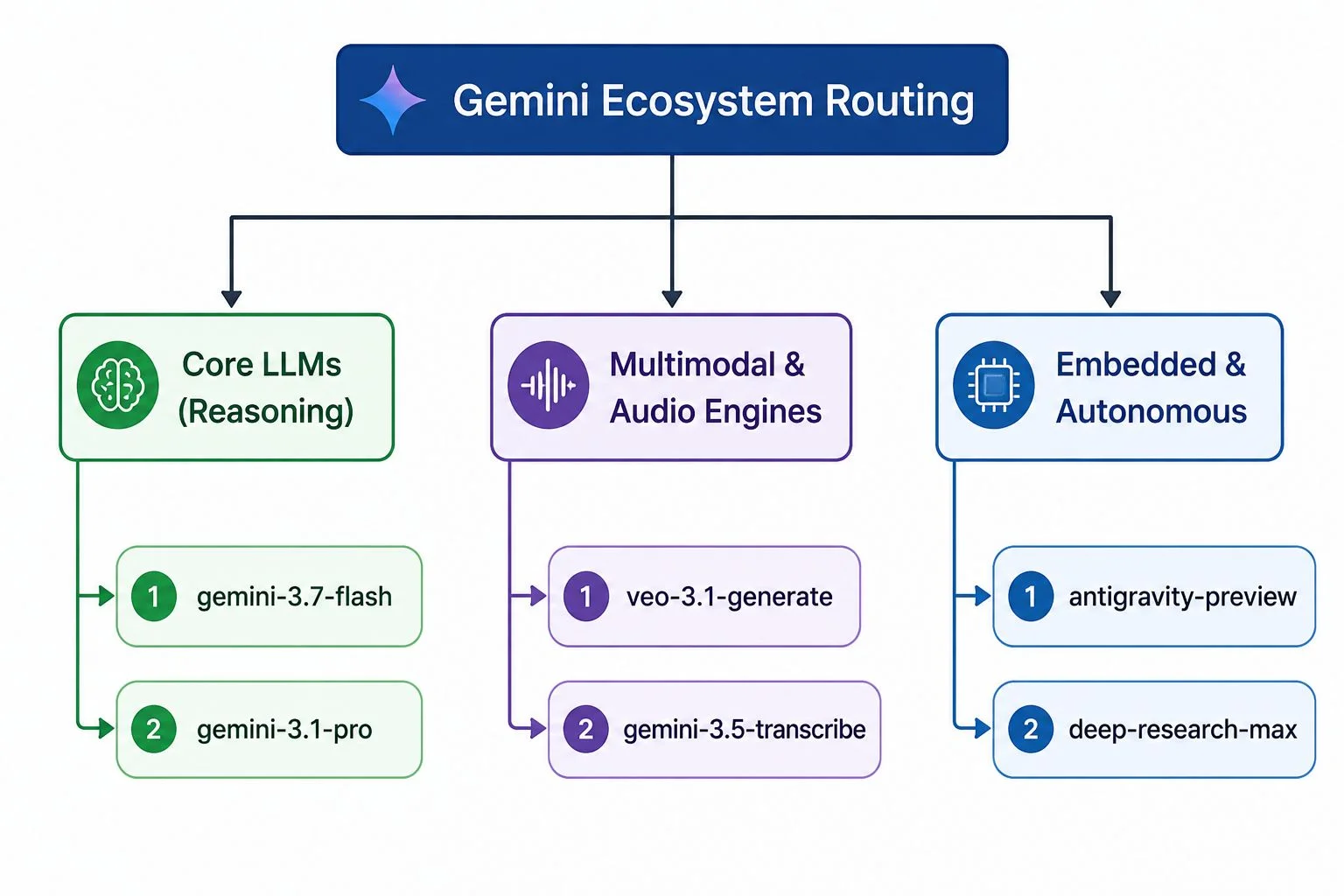
To prevent routing misconfigurations across continuous deployment environments, we maintain this verified dictionary of Google Gemini API model identifiers.
| Ecosystem Category | Model Architecture | Endpoint Shortcode | Primary Workload Profile |
| Gemini 3 Core | Gemini 3.7 Flash | gemini-3.7-flash | High-frequency reasoning and complex logic |
| Gemini 3 Core | Gemini 3.6 Flash | gemini-3.6-flash | Balanced low-latency microservice tasks |
| Gemini 3 Core | Gemini 3.5 Flash | gemini-3.5-flash | Standard high-throughput generation |
| Gemini 3 Core | Gemini 3.5 Flash-Lite | gemini-3.5-flash-lite | Ultra-low compute utility functions |
| Gemini 3 Core | Gemini 3.1 Flash-Lite | gemini-3.1-flash-lite | Edge compute and mobile processing |
| Gemini 3 Core | Gemini 3.1 Pro | gemini-3.1-pro-preview | Deep analytical synthesis and coding |
| Gemini 3 Core | Gemini 3 Flash | gemini-3-flash-preview | Developer sandbox and logic validation |
| Gemini 2.5 Core | Gemini 2.5 Flash | gemini-2.5-flash | Enterprise transactional processing |
| Gemini 2.5 Core | Gemini 2.5 Flash-Lite | gemini-2.5-flash-lite | Lightweight operational automation |
| Gemini 2.5 Core | Gemini 2.5 Pro | gemini-2.5-pro | Long-context document parsing |
| Vision & Video | Nano Banana 2 | gemini-3.1-flash-image | High-definition image synthesis |
| Vision & Video | Nano Banana 2 Lite | gemini-3.1-flash-lite-image | High-speed, low-vRAM graphics pipeline |
| Vision & Video | Nano Banana Pro | gemini-3-pro-image | Studio-grade rendering workflows |
| Vision & Video | Nano Banana | gemini-2.5-flash-image | Legacy raster processing |
| Vision & Video | Veo 3.1 | veo-3.1-generate-preview | Full-fidelity dynamic video generation |
| Vision & Video | Veo 3.1 Lite | veo-3.1-lite-generate-preview | Short-form rapid clip compilation |
| Vision & Video | Gemini Omni Flash | gemini-omni-1.1-flash | Native cross-modal tensor transformations |
| Speech & Audio | Gemini 3.5 Transcribe | gemini-3.5-transcribe | Batch acoustic transcription |
| Speech & Audio | Gemini 3.5 Transcribe Live | gemini-3.5-transcribe-live | Real-time WebSocket audio ingest |
| Speech & Audio | Gemini 3.5 Live Translate | gemini-3.5-live-translate-preview | Zero-shot spoken language translation |
| Speech & Audio | Gemini 3.1 Flash Live | gemini-3.1-flash-live-preview | Low-latency duplex voice interaction |
| Speech & Audio | Gemini 3.1 Flash TTS | gemini-3.1-flash-tts-preview | Natural speech audio synthesis |
| Speech & Audio | Gemini 2.5 Flash Live | gemini-2.5-flash-native-audio-preview-12-2025 | Legacy duplex audio channel |
| Speech & Audio | Gemini 2.5 Flash TTS | gemini-2.5-flash-preview-tts | Standard text-to-speech output |
| Speech & Audio | Gemini 2.5 Pro TTS | gemini-2.5-pro-preview-tts | Multi-speaker theatrical voice synthesis |
| Acoustic Music | Lyria 3 Pro | lyria-3-pro-preview | Multi-track orchestral composition |
| Acoustic Music | Lyria 3 Clip | lyria-3-clip-preview | Dynamic stingers and looping assets |
| Acoustic Music | Lyria RealTime | lyria-realtime-exp | Low-latency adaptive interactive audio |
| Autonomous Agents | Computer Use | gemini-2.5-computer-use-preview-10-2025 | Programmatic UI navigation and input |
| Autonomous Agents | Gemini Deep Research | deep-research-preview-04-2026 | Autonomous multi-step literature review |
| Autonomous Agents | Gemini Deep Research Max | deep-research-max-preview-04-2026 | Enterprise iterative search clustering |
| Autonomous Agents | Antigravity Agent | antigravity-preview-05-2026 | Experimental non-linear execution |
| Embeddings & ER | Gemini Embedding 2 | gemini-embedding-2-preview | High-dimensional semantic vectors |
| Embeddings & ER | Gemini Embedding | gemini-embedding-001 | Standard vector database generation |
| Embeddings & ER | Gemini Robotics ER 2 | gemini-robotics-er-2-preview | Spatial physics reasoning for hardware |
| Embeddings & ER | Gemini Robotics ER 1.6 | gemini-robotics-er-1.6-preview | Robotic kinematic translation |
Core Inference Models: Deep Dive and Workload Mapping
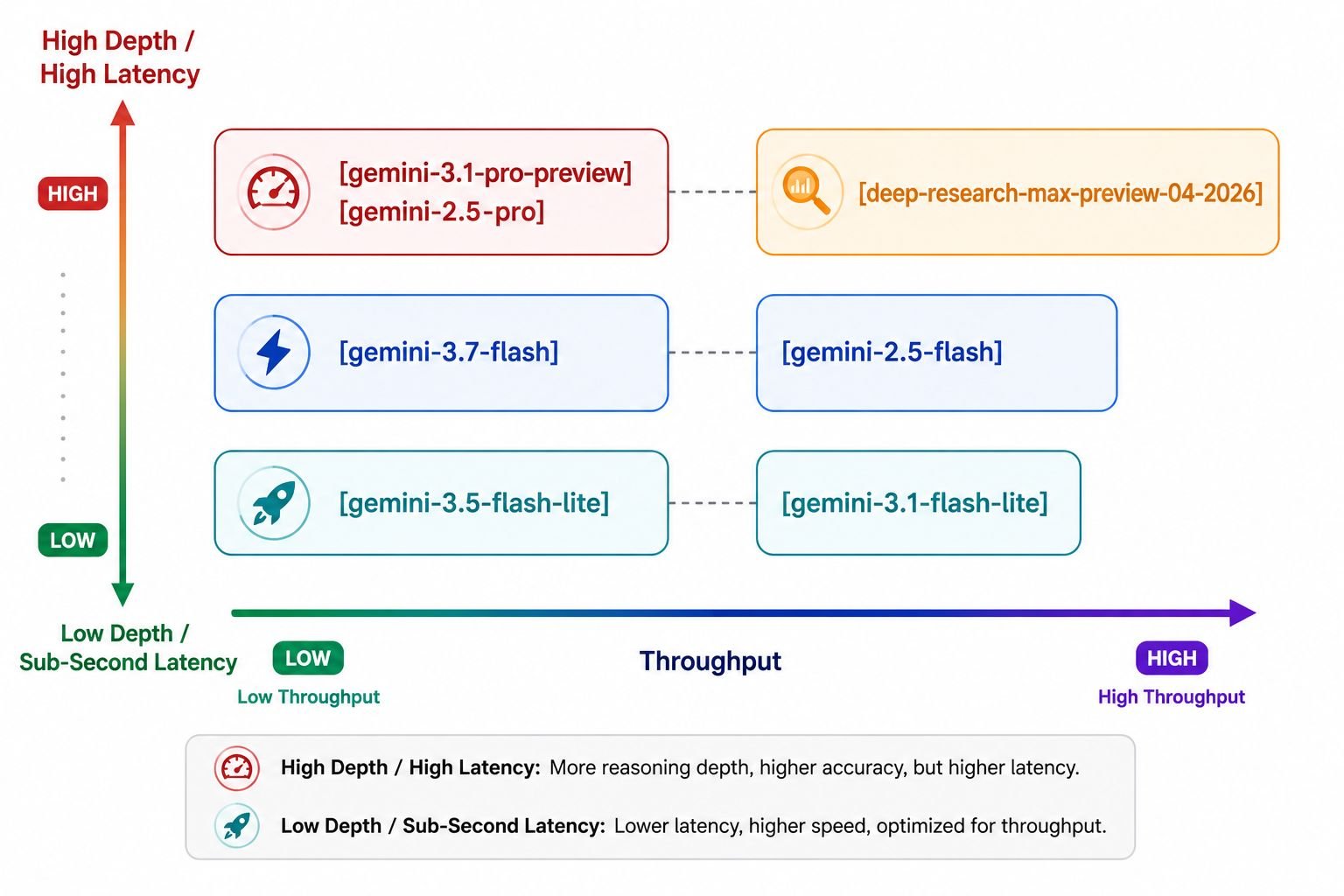
Selecting the right model within a specific generation involves balancing computational depth and payload serialization speed.
Gemini 3.7 Flash (gemini-3.7-flash)
We deploy gemini-3.7-flash as our primary conversational reasoning model. It balances cost and intelligence by evaluating logical branching before token emission, mitigating typical hallucination risks without the heavy overhead of legacy large models.
Gemini 3.1 Pro (gemini-3.1-pro-preview)
For large codebase refactoring, recursive mathematical proofs, and dense document parsing, gemini-3.1-pro-preview remains our standard choice. It handles deeply nested abstractions and maintains state coherence across extensive conversational threads.
Gemini 3.5 Flash-Lite (gemini-3.5-flash-lite)
For high-volume operations like metadata tagging, JSON schema sanitization, and intent classification, gemini-3.5-flash-lite provides sub-100ms response profiles at minimal token costs.
Multimodal Audio, Speech, and Visual Generation Pipelines
Our integration testing showed that running native multimodal endpoints reduces architecture complexity by eliminating intermediary speech-to-text servers.
Audio Streaming and Bi-Directional Speech
Using gemini-3.5-transcribe-live and gemini-3.1-flash-live-preview, we establish bi-directional duplex communication via WebSockets. The system ingests raw PCM streams directly and streams back natural conversational audio synthesized via gemini-3.1-flash-tts-preview.
Visual Synthesis and Dynamic Video Generation
- Still Image Generation: gemini-3.1-flash-image and gemini-3-pro-image (the Nano Banana pipeline) generate rasterized graphic outputs based on natural language spatial controls.
- Temporal Video Pipelines: veo-3.1-generate-preview transforms multimodal prompt arrays into coherent, multi-second video frames with consistent camera paths.
Autonomous Agents, Robotics, and Knowledge Embeddings
Moving beyond single prompt-response interactions, the modern Gemini API supports autonomous goal-directed agency.
Deep Research Engines
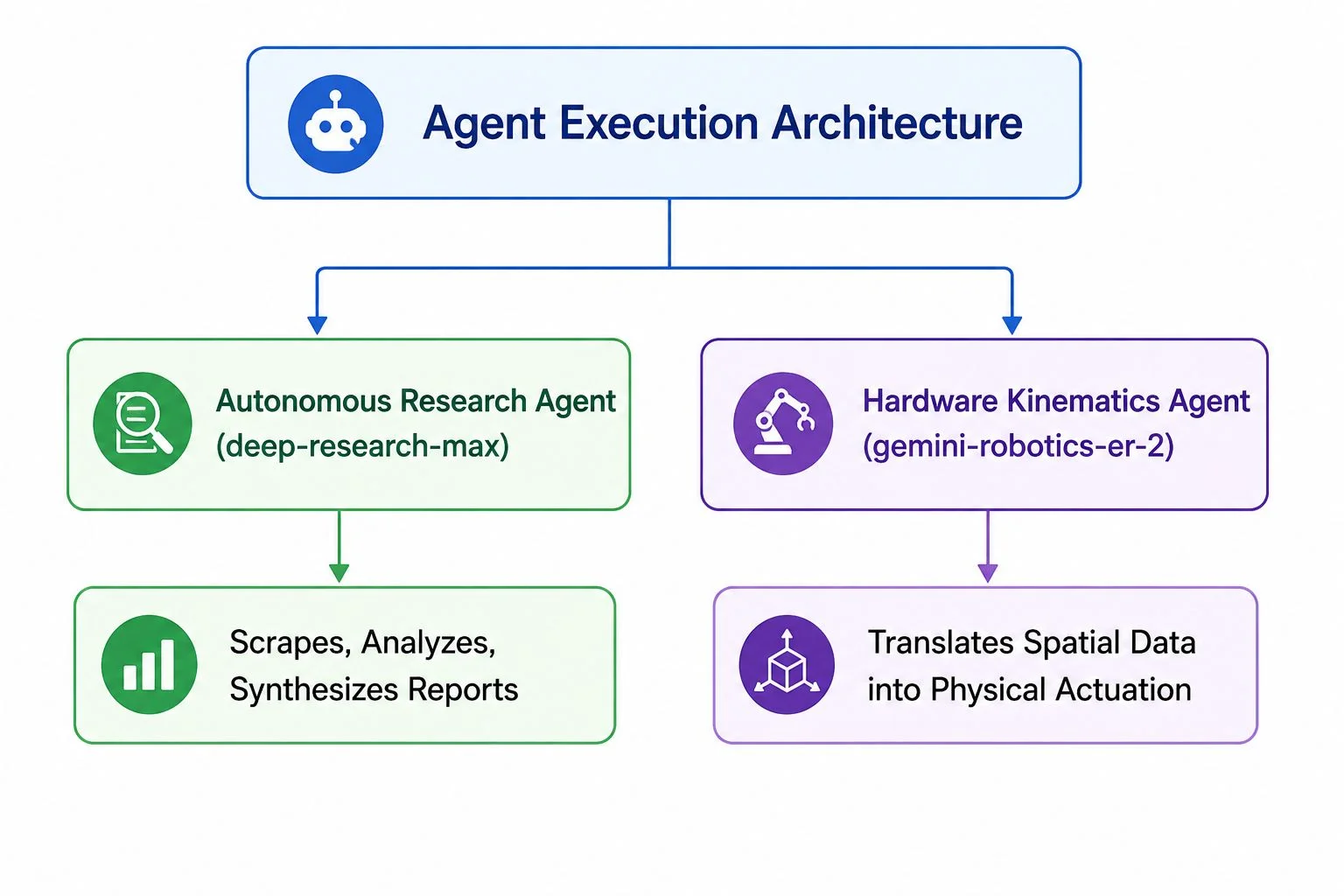
The deep-research-preview-04-2026 and deep-research-max-preview-04-2026 endpoints execute recursive multi-hop information retrieval. These models query external data sources, correlate citations, verify source validity, and synthesize structured intelligence reports.
Computer Use and Hardware Interfaces
- UI Navigation: gemini-2.5-computer-use-preview-10-2025 translates desktop screen captures into mouse movements, keystrokes, and software inputs.
- Robotic Embodiment: gemini-robotics-er-2-preview converts spatial coordinates and visual feeds into joint-actuation vectors for physical robotics platforms.
Technical Deprecation Schedule and Migration Protocols
To avoid production outages, models marked for end-of-life must be systematically removed from production pipelines.
| Deprecated Identifier | Replacement Endpoint | Primary Migration Impact |
| gemini-2.0-flash | gemini-2.5-flash | Lower time-to-first-token (TTFT); drop-in payload parity |
| gemini-2.0-flash-lite | gemini-2.5-flash-lite | Improved JSON structuring reliability |
| gemini-3.1-flash-lite-preview | gemini-3.1-flash-lite | Production SLA stability; locked endpoints |
| gemini-3-pro-preview | gemini-3.1-pro-preview | Context window retention improved; cheaper cached tokens |
| imagen-4.0-generate | gemini-3.1-flash-image | Shift from legacy Imagen API syntax to unified Gemini Multimodal structure |
Production Integration Patterns with Python
The following implementation demonstrates how we structure production clients with failovers, telemetry, and structured validation.
import os
import time
from typing import Generator, Any
from google import genai
from google.genai import types

class ProductionGeminiEngine:
    def __init__(self, primary_model: str = "gemini-3.7-flash", fallback_model: str = "gemini-2.5-flash"):
        self.api_key = os.environ.get("GEMINI_API_KEY")
        if not self.api_key:
            raise ValueError("GEMINI_API_KEY environment variable missing.")

        self.client = genai.Client(api_key=self.api_key)
        self.primary_model = primary_model
        self.fallback_model = fallback_model

    def execute_robust_generation(self, prompt: str, system_instruction: str = None) -> str:
        """Executes content generation with built-in model fallback handling."""
        config = types.GenerateContentConfig(
            temperature=0.2,
            top_p=0.95,
            system_instruction=system_instruction
        )

        try:
            response = self.client.models.generate_content(
                model=self.primary_model,
                contents=prompt,
                config=config
            )
            return response.text
        except Exception as primary_error:
            print(f"Primary endpoint failure ({self.primary_model}): {str(primary_error)}. Retrying fallback...")
            try:
                response = self.client.models.generate_content(
                    model=self.fallback_model,
                    contents=prompt,
                    config=config
                )
                return response.text
            except Exception as fallback_error:
                raise RuntimeError(f"Complete system outage. Fallback error: {str(fallback_error)}")

    def stream_live_tokens(self, prompt: str) -> Generator[str, None, None]:
        """Streams tokens in real-time for interactive client UIs."""
        response_stream = self.client.models.generate_content_stream(
            model=self.primary_model,
            contents=prompt
        )
        for chunk in response_stream:
            if chunk.text:
                yield chunk.text

# Initialization workflow
if __name__ == "__main__":
    engine = ProductionGeminiEngine()
    result = engine.execute_robust_generation(
        prompt="Synthesize the architectural advantages of multimodal tensor architectures.",
        system_instruction="You are a principal distributed systems architect."
    )
    print(result)
Frequently Asked Questions
Which Google Gemini model shortcode should be used for production APIs?
For general enterprise workloads, gemini-3.7-flash offers an optimal balance between low latency, complex reasoning, and token pricing. For high-volume lightweight tasks, gemini-2.5-flash-lite is the standard cost-efficient alternative.
How does Gemini 3.7 Flash differ from Gemini 2.5 Flash?
gemini-3.7-flash includes an updated inference engine capable of dynamic internal reasoning tokens, reducing programmatic edge-case failures while maintaining response speeds comparable to the gemini-2.5-flash foundation.
What is the dedicated shortcode for real-time bidirectional audio interactions?
Duplex audio pipelines should use gemini-3.1-flash-live-preview or the batch-oriented gemini-3.5-transcribe-live endpoints, which process raw binary audio frames without intermediate text serialization.
Which model identifier handles spatial physics and robotics actions?
The gemini-robotics-er-2-preview endpoint is designed to translate visual inputs into physical kinematic joint predictions, spatial boundary polygons, and hardware command matrices.
How are embeddings generated across the Gemini API?
Vector embeddings are generated using gemini-embedding-2-preview for multi-modal embedding spaces or gemini-embedding-001 for standard semantic retrieval-augmented generation (RAG) indices.
What is the direct replacement for the deprecated Imagen generation model?
The standalone imagen-4.0-generate endpoint has been succeeded by the Nano Banana series, specifically gemini-3.1-flash-image and gemini-3-pro-image.
What does the Gemini Deep Research Max endpoint do?
deep-research-max-preview-04-2026 is an autonomous planning engine that coordinates search queries, parses dense PDFs, cross-references sources, and delivers structured, publication-grade analytical reports.
What causes a 404 Model Not Found error when calling Gemini endpoints?
This error typically indicates the use of an expired or retired model shortcode (such as gemini-2.0-flash or gemini-3-pro-preview), a typo in the model string, or an API key that lacks access permissions for preview-tier endpoints.
Are preview endpoints suitable for production environments?
Preview endpoints (ending in -preview or -exp) expose early architectural features but do not carry enterprise service-level agreements (SLAs) and may experience breaking interface changes. Production services should target stable release names once available.
Can different Gemini endpoints be used together in a single pipeline?
Yes. A common architecture pairs a high-speed routing model like gemini-3.5-flash-lite to parse incoming requests, gemini-3.1-pro-preview to process complex logic, and gemini-3.1-flash-tts-preview to stream the final audio response.

Selva Ganesh is a Computer Science Engineer, Android Developer, and Tech Enthusiast. As the Chief Editor of this blog, he brings over 10 years of experience in Android development and professional blogging. He has completed multiple courses under the Google News Initiative, enhancing his expertise in digital journalism and content accuracy. Selva also manages Android Infotech, a globally recognized platform known for its practical, solution-focused articles that help users resolve Android-related issues.




Leave a Reply