
Android Alternatives for Apple iPhone Duo– When we first handled the iPhone Duo, the shift in the mobile computing landscape became undeniable. Apple entered the foldable arena with a distinct passport form factor, engineering marvels like nano-texture glass, and the powerful Apple A20 Pro chip. Yet, our extended real-world testing quickly revealed the trade-offs: an eye-watering starting price of nearly two thousand dollars, the omission of a dedicated optical telephoto sensor, the sudden absence of Face ID in favor of side-mounted Touch ID, and a multitasking environment in iOS 27 that still limits users to two active windows.
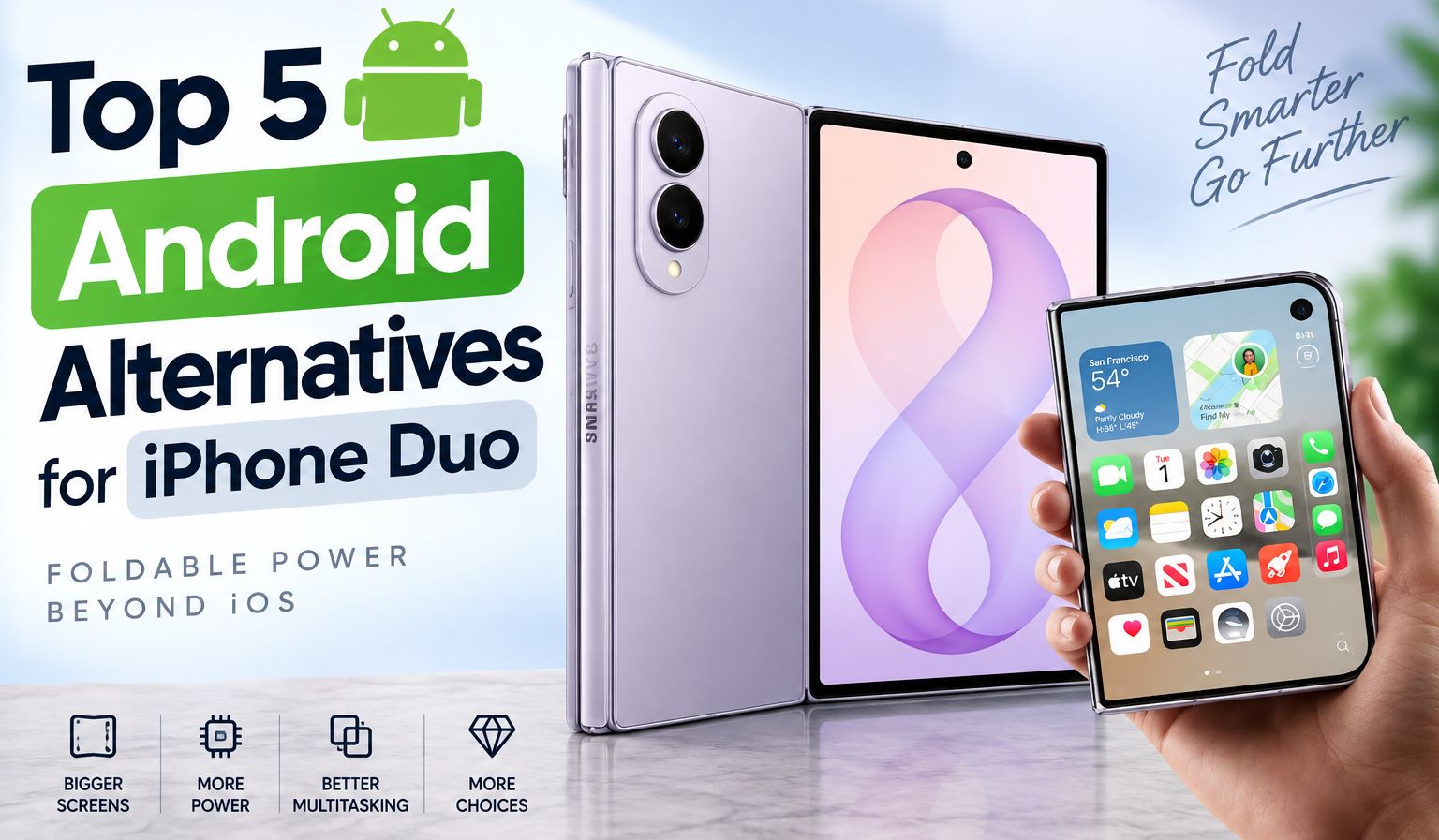

For power users, mobile creators, and professionals who demand uncompromised hardware, superior software maturity, or simply better value for money, the market offers several compelling options. We spent weeks evaluating every leading alternative side-by-side to deliver an authoritative breakdown of the best devices available right now.
1. Samsung Galaxy Z Fold 8: The Multitasking Powerhouse
The Samsung Galaxy Z Fold 8 stands as the benchmark against which every modern book-style foldable must be measured. Having iterated on folding hinge geometry, structural durability, and display layer resilience across eight product cycles, Samsung delivers an experience that feels remarkably refined.
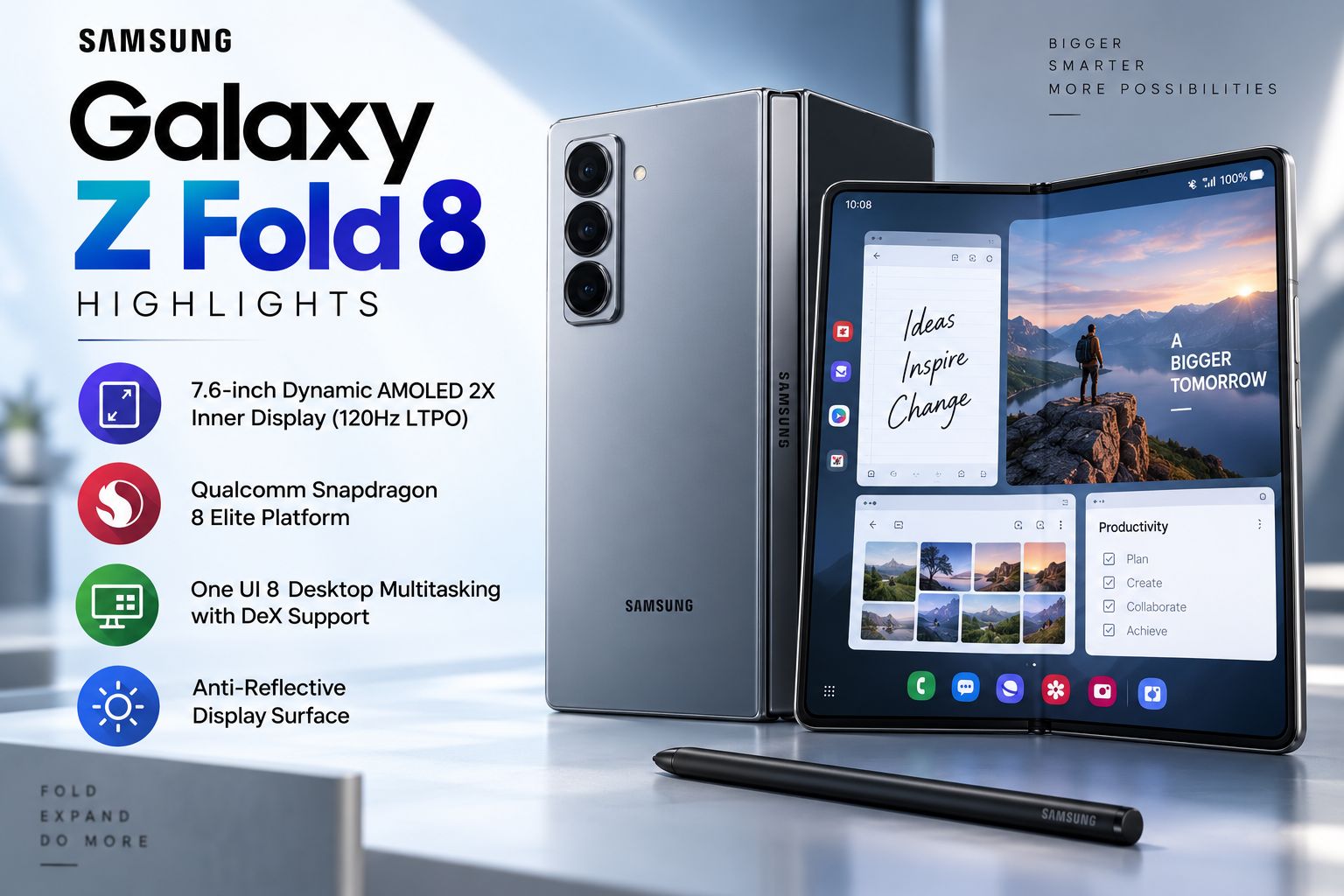
When we set the Galaxy Z Fold 8 next to the iPhone Duo, the most glaring contrast emerged in multitasking productivity. While the iPhone Duo restricts you to two side-by-side apps, One UI lets us orchestrate three split-screen applications while running additional utility windows in floating pop-up views. Furthermore, dragging and dropping assets across windows feels effortless.
Under the hood, the Qualcomm Snapdragon 8 Elite processor ensures that thermal throttling is virtually nonexistent during intense sustained sessions. While Samsung opted to trim down overall chassis thickness—at the expense of native internal stylus containment—the sheer ergonomic comfort of the Fold 8 in the pocket gives it an immediate edge over heftier alternatives.
Key Specifications:
-
Displays: 7.6-inch Dynamic AMOLED 2X inner panel (1–120Hz); 5.5-inch cover screen
-
Processor: Qualcomm Snapdragon 8 Elite
-
RAM & Storage: 12GB/16GB RAM; 256GB to 1TB storage
-
Camera System: 50MP primary sensor with OIS, 50MP ultra-wide, and dedicated optical telephoto module
-
Software: Android with One UI (7 full years of OS updates)
2. Google Pixel 11 Pro Fold: Pure Android and Computational Camera Superiority
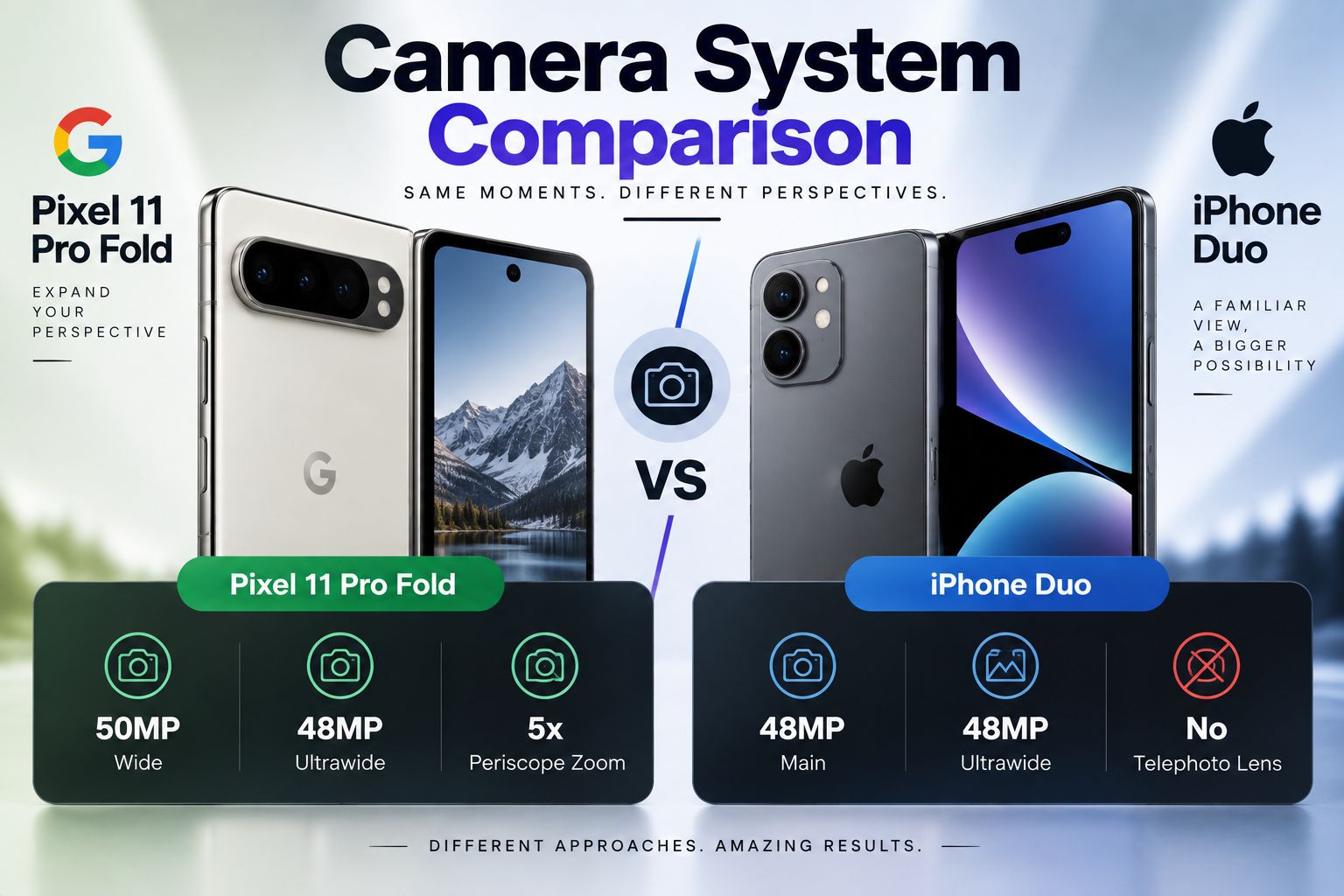
Google took a different philosophical route with the Google Pixel 11 Pro Fold, crafting an expansive external screen paired with an exceptionally immersive inner workspace. Where the iPhone Duo cut corners on its camera setup by omitting a true periscope telephoto lens, Google doubled down on imaging excellence.
In our field photography tests across low-light cityscapes and fast-moving subjects, the Pixel 11 Pro Fold consistently captured images with superior dynamic range, zero shutter lag, and deep, natural contrast. The dedicated 5x periscope telephoto lens paired with Google Super Res Zoom algorithms outperforms the digital 2x crop of Apple’s Dual Fusion system by a wide margin.
The device also shares the rugged IP68 dust and water resistance standard, matching Apple’s ingress protection while outperforming Samsung’s dust thresholds. Google’s Tensor processor prioritizes on-device machine learning, powering real-time transcription, live translation, and intuitive contextual voice actions that run rings around early voice assistant betas.
Key Specifications:
-
Displays: 8.0-inch Super Actua Flex inner display; 6.4-inch outer OLED panel
-
Durability: IP68 certified dust and water resistance
-
Processor: Google Tensor architecture with dedicated Titan security co-processor
-
Cameras: 50MP wide main, 48MP ultrawide with Macro Focus, 10.8MP 5x optical telephoto
-
Battery: High-capacity cell with comprehensive 24-hour endurance ratings
3. OnePlus Open 2: The Eradicated Crease and Lightweight Flagship
Few devices have challenged hardware engineering conventions as aggressively as the OnePlus Open series. The OnePlus Open 2 perfects the physical form factor of the book-style foldable by virtually eliminating the display crease altogether.
While Apple implemented a matte nano-texture finish on the iPhone Duo to mask the fold visually, we noticed that running our fingers across the center still produces a distinct tactical trough. The OnePlus Open 2, in contrast, uses a proprietary Flexion Hinge constructed with aerospace-grade cobalt and carbon fiber alloys, spreading the bend radius so evenly that the screen feels nearly as flat as a conventional glass slab.
Why the OnePlus Open 2 Rivals the iPhone Duo:
-
Open Canvas Multitasking: Rather than cramming windows into microscopic squares, OnePlus utilizes an expandable desktop that spans beyond the physical display edges, letting you flick between full-screen workspaces fluidly.
-
Rapid Charging: Where Apple tops out around 30W to 45W wired charging, OnePlus includes 80W SuperVOOC fast-charging hardware in the box, bringing the battery from flat to full in just over thirty minutes.
-
Hasselblad Color Calibration: Outstanding color science, natural portrait rendering, and expansive sensor surfaces make it a favorite for mobile photographers.
4. Honor Magic V3: Record-Breaking Thinness and Battery Chemistry
If your hesitation with the iPhone Duo stems from bulk and weight in your pocket, the Honor Magic V3 is an engineering revelation. Measuring under 9.5mm when folded closed, this device feels nearly indistinguishable from a standard non-folding flagship phone.
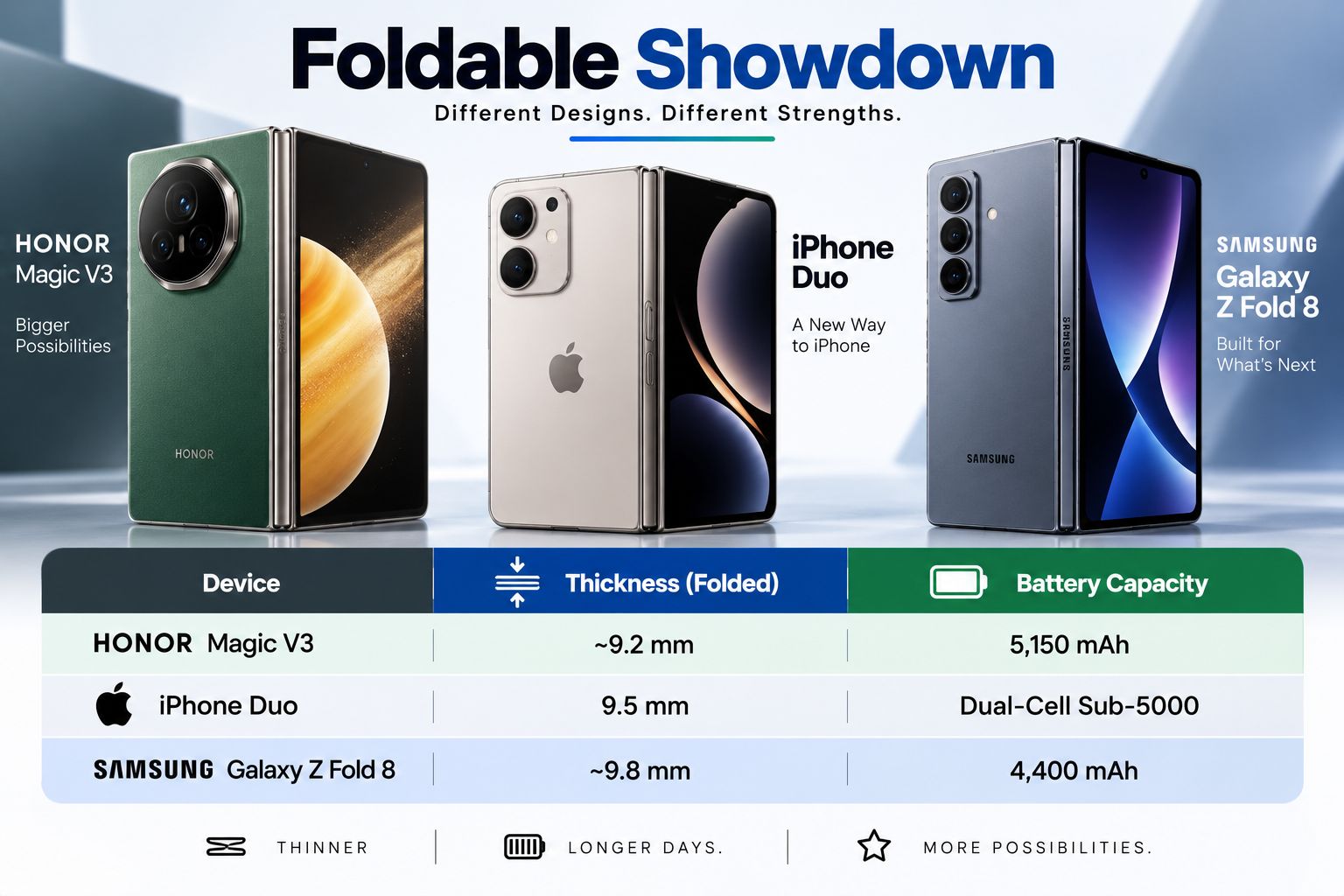
To achieve this profile without crippling battery life, Honor utilized advanced silicon-carbon anode battery technology. This allows for a massive 5,150mAh battery capacity packed into a chassis that remains remarkably thin and lightweight. During our battery drain tests, the Magic V3 easily sailed past the 24-hour mark under heavy productivity workflows, outlasting the iPhone Duo’s dual-battery architecture by several hours.
The outer display features a familiar, comfortable aspect ratio that allows for two-handed typing without cramping your thumbs, while the inner panel reaches up to 5,000 nits peak HDR brightness, ensuring exceptional outdoor legibility under direct sunlight.
5. Vivo X Fold 3 Pro: Zero-Compromise Imaging and Dual Ultrasonic Biometrics
The Vivo X Fold 3 Pro addresses two of the biggest compromises present on Apple’s foldable: biometric convenience and telephoto camera performance.
Apple’s switch to a side-mounted power button scanner on the Duo feels like a regression for users accustomed to unlocking their devices seamlessly via 3D Face ID. Vivo solved this problem by integrating 3D Ultrasonic Under-Display Fingerprint Scanners into both the outer and inner screens. Whether the phone is open on a desk or closed in your palm, biometric authentication is instantaneous, responsive, and unaffected by wet hands.
Furthermore, Vivo collaborated closely with ZEISS optics to equip the device with a 64MP periscope telephoto sensor featuring floating lens elements capable of true macro telephoto captures. For users who prioritize concert photography, sports, portraits, and extreme close-up detail, the imaging system on the X Fold 3 Pro leaves the iPhone Duo far behind.
Direct Comparison: How the Top Alternatives Stack Up
| Smartphone Model | Primary Strength | Screen Architecture | Stylus Support | Water Resistance |
| Apple iPhone Duo | A20 Pro 2nm Silicon | 7.6″ Inner / 5.4″ Outer | Apple Pencil | IP68 |
| Samsung Galaxy Z Fold 8 | Multi-Window UI Maturity | 7.6″ Inner / 5.5″ Outer | S Pen Ecosystem | IP48 |
| Google Pixel 11 Pro Fold | Telephoto Camera & AI | 8.0″ Inner / 6.4″ Outer | None | IP68 |
| OnePlus Open 2 | Crease Eradication & Speed | 7.82″ Inner / 6.31″ Outer | Active Stylus | IPX4 / IP48 |
| Honor Magic V3 | Ultra-Thin Body Profile | 7.92″ Inner / 6.43″ Outer | Dual Screen Pen | IPX8 |
| Vivo X Fold 3 Pro | ZEISS Pro Optical Zoom | 8.03″ Inner / 6.53″ Outer | Active Stylus | IPX8 |
Critical Buying Factors: How We Chose the Best Options
When we evaluate premium foldable smartphones, we look beyond the spec sheets. A foldable device introduces complex mechanical hinge dynamics, thermal trade-offs, and software demands that typical smartphones never encounter. Here are the core pillars we scrutinized:
1. Hinge Engineering and Crease Management
A fragile hinge ruins the premium experience. We look for zero-gap teardrop hinges that seal tightly against debris while distributing mechanical tension across the display substrate. The OnePlus Open 2 and Samsung Galaxy Z Fold 8 demonstrate exceptional long-term structural integrity without exhibiting inner panel lift or hairline stress fractures.
2. Software Optimization and Split-Screen Dexterity
A large 7.6-inch to 8-inch canvas is wasted if the underlying operating system treats it as an enlarged mobile phone interface. Samsung’s One UI and OnePlus’s Open Canvas allow users to save multi-app pair combinations, run three full-fledged windows simultaneously, and swap tasks without stuttering. This remains one of Apple’s clearest weak points in the debut version of iOS on foldables.
3. Camera Versatility Without Structural Sacrifices
Because folding phones must stack two halves together, manufacturers frequently strip out periscope telephoto zoom hardware to save interior space. While Apple chose this exact compromise on the iPhone Duo, devices like the Google Pixel 11 Pro Fold and Vivo X Fold 3 Pro prove that flagship-grade optical zoom and large primary sensors can indeed fit into foldable chassis.
4. Charging Speed and Battery Longevity
Inner OLED displays draw significantly more power than standard smartphone screens. Having fast-charging protocols—such as Honor’s and OnePlus’s rapid charging capabilities—ensures you are never tethered to a wall outlet for hours when using your phone as a mobile tablet workstation.
The Final Verdict
The iPhone Duo is a technical milestone for Apple loyalists, but it is by no means the undisputed king of the foldable category. If your primary goal is unmatched productivity and mature software, the Samsung Galaxy Z Fold 8 remains our top recommendation. For mobile photography enthusiasts, the Google Pixel 11 Pro Fold stands in a league of its own with superior optical zoom and AI computational imaging.
If comfort, minimal weight, and an invisible crease top your priority list, pick the OnePlus Open 2 or the Honor Magic V3. Each of these alternatives delivers proven hardware reliability, advanced multitasking, and high-end hardware execution without forcing you into early-adopter compromises.
Frequently Asked Questions
Which alternative to the iPhone Duo has the best camera system?
The Google Pixel 11 Pro Fold and Vivo X Fold 3 Pro both outperform the iPhone Duo in pure photography versatility. While the iPhone Duo relies on a dual-camera system with digital cropping, both the Pixel and the Vivo incorporate true periscope telephoto lenses for superior lossless long-range zooming.
Does the Samsung Galaxy Z Fold 8 support stylus input?
Yes, the Galaxy Z Fold 8 supports Samsung’s S Pen on its large inner folding display, allowing for precise note-taking, sketching, and document signing.
Why doesn’t the iPhone Duo feature Face ID?
Due to the extreme thinness of the display panels when unfolded, Apple could not fit the complex infrared dot projector and TrueDepth camera array into the bezels, opting instead for a fingerprint scanner integrated into the side power button.
Which foldable phone has the least visible crease?
The OnePlus Open 2 features the most seamless display surface in the industry. Its wide-radius droplet hinge design distributes panel stress so smoothly that the crease is practically invisible during daily usage.
Are these foldable alternatives dust resistant?
The Google Pixel 11 Pro Fold matches the iPhone Duo with a certified IP68 rating, protecting it against both fine dust ingress and prolonged water immersion. The Galaxy Z Fold 8 holds an IP48 rating.
Can I run more than two apps on the Galaxy Z Fold 8?
Yes. Samsung’s One UI allows you to run up to three split-screen applications simultaneously on the inner display, with additional apps available as floating pop-up windows.
Which alternative offers the longest battery life?
The Honor Magic V3 leads the category in battery endurance thanks to its advanced high-density silicon-carbon battery cells, outlasting the standard dual-battery setups of competitors.
Is the crease on the iPhone Duo noticeable compared to rivals?
Apple uses a nano-texture matte surface to diffuse reflections across the fold line, which reduces visual glare; however, the physical groove is still palpable to the touch and comparable to modern devices from Samsung.
Do any of these alternatives support desktop mode?
Yes. The Samsung Galaxy Z Fold 8 features Samsung DeX, allowing you to plug your phone into an external monitor, keyboard, and mouse for a desktop-class computing experience.
Which foldable alternative is the thinnest to carry?
The Honor Magic V3 is widely celebrated as one of the thinnest book-style foldables ever made, measuring less than 9.5mm thick when completely folded closed.

Selva Ganesh is a Computer Science Engineer, Android Developer, and Tech Enthusiast. As the Chief Editor of this blog, he brings over 10 years of experience in Android development and professional blogging. He has completed multiple courses under the Google News Initiative, enhancing his expertise in digital journalism and content accuracy. Selva also manages Android Infotech, a globally recognized platform known for its practical, solution-focused articles that help users resolve Android-related issues.




Leave a Reply