
How to Improve Galaxy Watch Battery Life – Experiencing rapid battery drain on Samsung Galaxy Watch devices can disrupt daily routines, from fitness tracking to staying connected on the go. Fortunately, battery depletion is rarely caused by a hardware flaw. In most cases, rapid power drain stems from background processes, active network connections, and unoptimized display settings.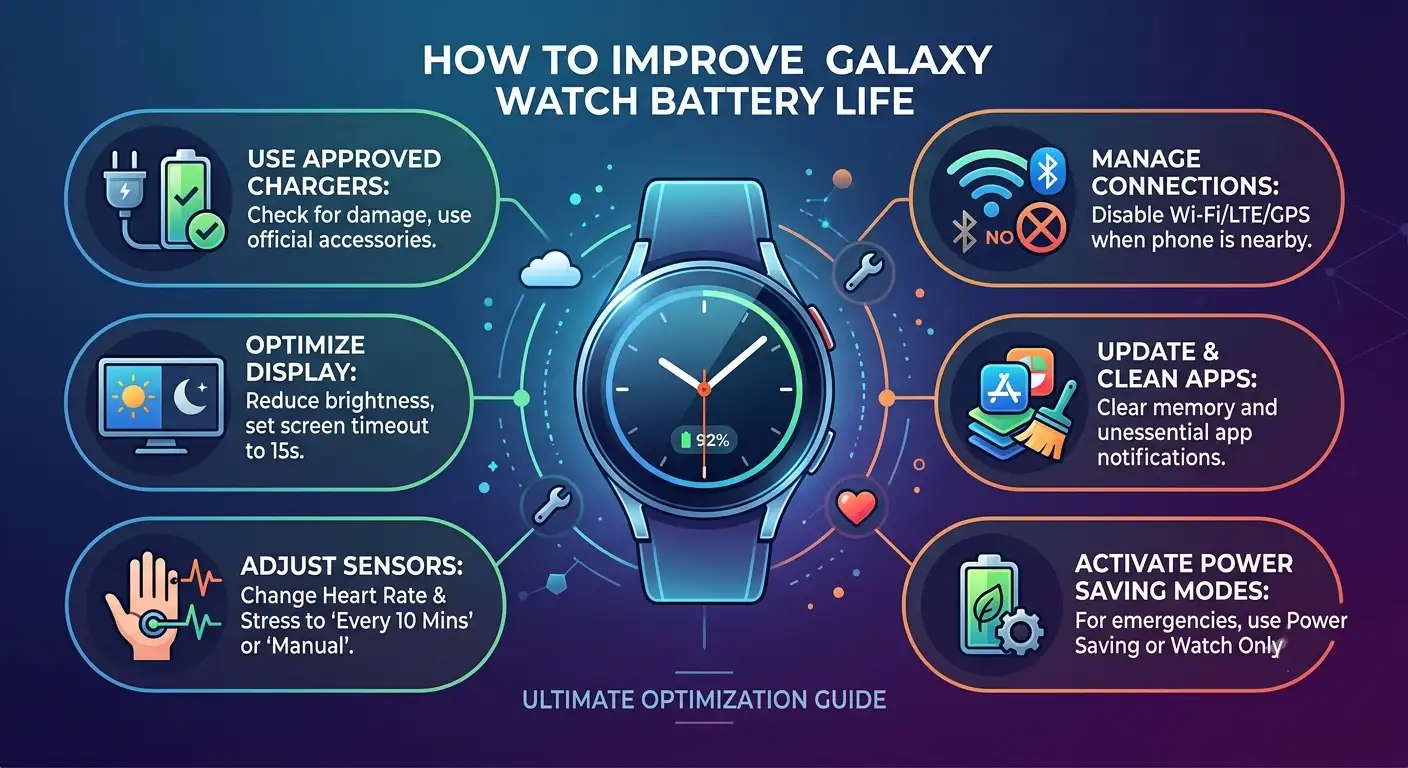
We have compiled this definitive, easy-to-follow guide to help optimize your Samsung Galaxy Watch for maximum daily endurance without sacrificing essential smart features.

1. Hardware and Charging Diagnostics
Before adjusting digital settings, verify the physical integrity of your smartwatch and power accessories. Hardware faults or improper charging equipment can mimic severe software-based battery issues.
-
Inspect physical components: Check your watch casing and charging pad for physical or liquid damage. Moisture or corrosion inside the contacts prevents optimal power delivery.
-
Use Samsung-approved chargers: Always charge your device with official Samsung-approved wireless chargers. Third-party charging docks often fail to regulate voltage correctly, leading to overheating, inefficient charging cycles, and accelerated long-term battery degradation.
-
Avoid temperature extremes: Lithium-ion batteries perform poorly under high environmental stress. Exposing your Galaxy Watch to sub-zero temperatures or leaving it in a direct-sunlight vehicle degrades chemical battery health rapidly.
2. Display Settings Optimization
The high-resolution AMOLED display on your Galaxy Watch is its single largest consumer of battery power. Strategic visual adjustments yield immediate gains in operational time.
Disable Always On Display (AOD)
The Always On Display feature keeps the screen lit continuously. Turning off AOD can extend your daily battery life by up to 30%.
-
Swipe up on your watch face to open the Apps screen.
-
Tap Settings (gear icon) and select Display.
-
Toggle off Always On Display.
Reduce Screen Brightness and Timeout
Set your screen brightness to a medium level (around 40–50%) and set the screen timeout to 15 seconds. Enable Auto-Brightness so the display automatically dims in darker environments.
Choose Battery-Friendly Watch Faces
Dark or minimal watch faces consume significantly less power on AMOLED displays because black pixels are completely turned off. Avoid animated watch faces or those requiring constant real-time data feeds like live weather animations and live step counters.
3. Managing Wireless Connections
Constant search protocols for local wireless networks drain significant power reserves. Managing connectivity prevents background searching when these networks are not actively needed.
Disable Unnecessary Networks
When your watch is connected to your smartphone via Bluetooth, secondary connections like Wi-Fi, GPS, and LTE/Mobile Networks remain unnecessary for most basic operations.
-
Wi-Fi: Swipe down to access the Quick Settings panel and turn off Wi-Fi. Alternatively, go to Settings > Connections > Wi-Fi and switch to Off.
-
Location / GPS: Open Settings > Location and turn off location tracking when not running outdoor navigation or workout routes.
-
Mobile Networks (LTE Models): For LTE-enabled Galaxy Watches, set Mobile Networks to Auto instead of Always On, or turn it Off entirely when your paired phone is nearby.
4. Fine-Tuning Notifications and Alert Settings
Receiving notifications forces the watch processor to wake up, turn on the display, and activate the vibration motor. Customizing incoming alerts drastically lowers overall system power draw.
Customize Notification Delivery via Galaxy Wearable App
-
Open the Galaxy Wearable app on your connected smartphone.
-
Navigate to Watch Settings > Notifications.
-
Tap App Notifications and turn off alerts for non-essential applications (games, shopping apps, promotional alerts).
Disable Immediate Screen Activation
By default, some models illuminate the screen every time a notification arrives.
-
In the Notifications menu of your Galaxy Wearable app, tap Advanced notification settings.
-
Turn off Turn on screen and Show with details. This allows you to receive haptic vibration alerts without powering on the high-draw display panel automatically.
5. Optimizing Health and Fitness Trackers
Samsung Health continuously runs monitoring algorithms in the background. Tailoring continuous monitoring settings frees up processing power and saves energy.
Adjust Heart Rate Monitoring
Continuous real-time heart rate tracking keeps the optical sensor active 24/7.
-
Open Samsung Health on your watch.
-
Scroll to and select Heart Rate.
-
Access Auto HR Settings (or tap Settings at the bottom).
-
Change the continuous reading option to Every 10 mins while still or Manual only.
Disable Continuous Stress and Sleep Tracking
-
Stress Tracking: Open the Stress menu in Samsung Health, navigate to settings, and switch Auto Stress Settings to Off or Manual.
-
Blood Oxygen During Sleep: In Samsung Health Sleep settings, toggle off Blood oxygen during sleep and Snore detection if you do not strictly require overnight health analysis.
6. App Management and Storage Maintenance
Outdated apps, memory clutter, and rogue background software frequently cause excessive battery drain.
Update Watch Software and Applications
Developers issue updates to patch memory leaks and bugged routines that cause CPU overuse.
-
System Updates: Open the Galaxy Wearable app on your phone, go to Watch Settings, tap Watch Software Update, and select Download and install.
-
App Updates: Open the Galaxy Store on your watch or through the Galaxy Wearable app, navigate to My Apps or Updates, and perform an Update All.
Clean System Storage and Background Apps
Unused media files and stacked background applications consume system memory (RAM), increasing processing overhead.
-
Open the Galaxy Wearable app on your phone.
-
Select Watch Settings > About Watch (or Device Care / Storage depending on your One UI Watch version).
-
Tap Storage and remove cached audio files or images no longer needed on the wrist.
-
Tap RAM or Memory and execute a Clean Now action to clear active background processes.
7. Utilizing Built-In Power Saving Modes
When extended battery operation is required, built-in system power modes offer instant efficiency improvements.
Power Saving Mode
Activating Power Saving Mode limits CPU performance, disables Wi-Fi/LTE, switches the screen to a streamlined grayscale display, disables touch-wake gestures, and limits high-draw features while preserving core functions like calls, text messages, and Bluetooth notifications.
-
Quick Access: Swipe down from the top of the watch face to open Quick Settings and tap the Battery / Power Saving icon.
-
Settings Access: Go to Settings > Battery and toggle on Power saving.
Watch Only Mode
For emergency situations where power is almost fully depleted, enable Watch Only mode under Settings > Battery. This turns off all smartwatch software, disabling connectivity and fitness tracking entirely, leaving only a basic digital time display that can run for multiple days on low remaining power.
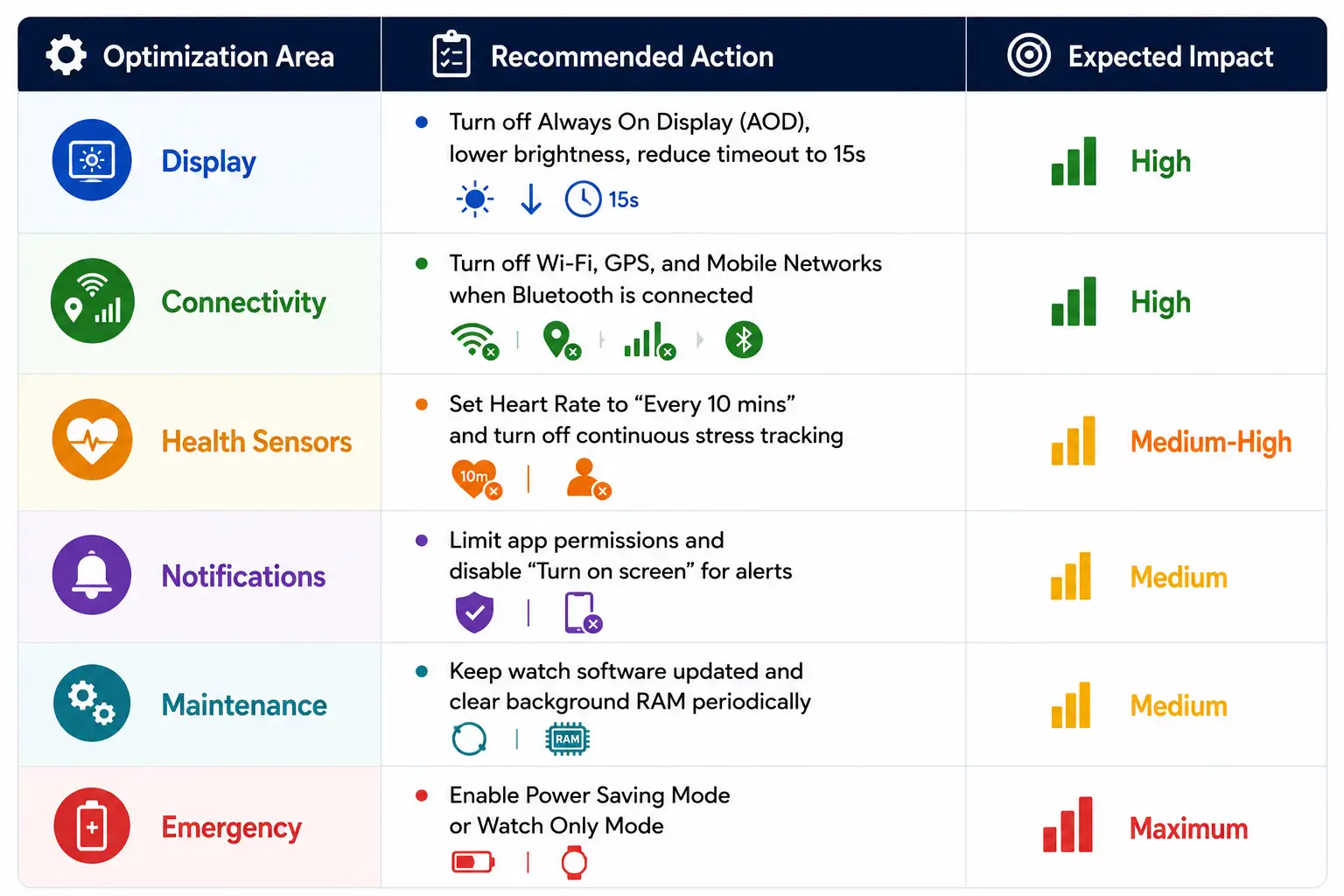
Summary Checklist for Galaxy Watch Battery Optimization

Selva Ganesh is a Computer Science Engineer, Android Developer, and Tech Enthusiast. As the Chief Editor of this blog, he brings over 10 years of experience in Android development and professional blogging. He has completed multiple courses under the Google News Initiative, enhancing his expertise in digital journalism and content accuracy. Selva also manages Android Infotech, a globally recognized platform known for its practical, solution-focused articles that help users resolve Android-related issues.




Restricting continuous stress monitoring along with heart rate tracking completely transformed my watch’s endurance. I now comfortably finish the day with over forty percent battery remaining.
I always kept the screen brightness maxed out for outdoor visibility, ignoring the massive battery penalty. Lowering it slightly and using adaptive brightness solved my rapid drain issues.
The tip about managing active network connections is spot on for anyone dealing with sudden power drops. Turning off standalone mobile data when near your phone saves massive amounts of power.
Disabling NFC when I am not actively using contactless payments prevented unnecessary background hardware polling. It is a minor security step that also preserves precious battery life.
Checking the battery usage breakdown in the companion app revealed exactly which process was misbehaving. Once I uninstalled that single rogue app, my battery life returned to normal.
Switching from animated watch faces to static, minimalist ones drastically reduced my hourly battery loss. Aesthetics are nice, but reliable all-day battery performance matters much more.
Optimizing background sync for messaging apps made my device run cooler and last much longer. When apps stop constantly polling the server, the battery finally gets a break.
Disabling the raise-to-wake feature completely stopped the screen from turning on accidentally inside my jacket pocket. That accidental activation was wasting a surprising amount of daily power.
It is reassuring to learn that hardware failure is rarely the root cause of these sudden power drains. A few targeted configuration adjustments can completely restore a sluggish device.
Managing the notification sound and vibration intensity settings also contributed to lower power usage throughout the day. Every little software tweak helps extend the overall charge.
Turning off Bluetooth audio syncing when I am not actively using headphones stopped random background connections. Small habits like this preserve battery life far better than expected.
I was ready to throw my smartwatch away before realizing how much power background heart rate tracking consumed. Adjusting that one metric brought my daily routine back to normal.
Limiting third-party complications on my watch face reduced the frequency of background data refreshes. Simplicity really is the ultimate key to better battery longevity here.
Clearing the cache partition after major system updates also helped smooth out erratic power consumption. It is a slightly hidden feature, but it works wonders for overall device health.
Switching off the standalone LTE mode when I am carrying my phone anyway eliminated unnecessary signal hunting. That background searching was the silent killer of my watch’s battery.
The advice regarding unoptimized display settings hit the nail right on the head. Once I dialed back the auto-brightness and turned off touch-to-wake, my battery performance skyrocketed.
Disabling automatic app updates over cellular networks prevented unexpected power drains while away from home. Keeping full control over when my watch downloads data has been a game changer.
Sleep tracking is fantastic, but leaving all the sensors active overnight drains nearly forty percent of the battery. Optimizing bedtime settings helped me maintain a healthy charge overnight.
Using a darker watch face with minimal colors uses significantly less power on OLED screens. It is a neat visual trick that genuinely extends your daily operating window.
Background syncing for email and weather apps was secretly chewing through my daily capacity. Restricting those sync intervals to manual or less frequent checks solved the problem.