
Things Sales Teams Can Do With SurveyMonkey– When most organizations evaluate SurveyMonkey, they view it exclusively as a mechanism for post-event surveys or human resources pulse checks. We made the identical miscalculation for years, treating survey software as an administrative tool rather than a core revenue engine. That changed when we systematically integrated structured surveys into every stage of our sales pipeline.

By treating surveys as interactive qualification, engagement, and discovery touchpoints, we uncovered proprietary deal intelligence that traditional cold outreach and rigid discovery calls routinely missed. What follows is our comprehensive operational blueprint detailing the twenty-five concrete tactics we use to accelerate sales velocity, qualify prospects accurately, and drive long-term customer retention with SurveyMonkey.
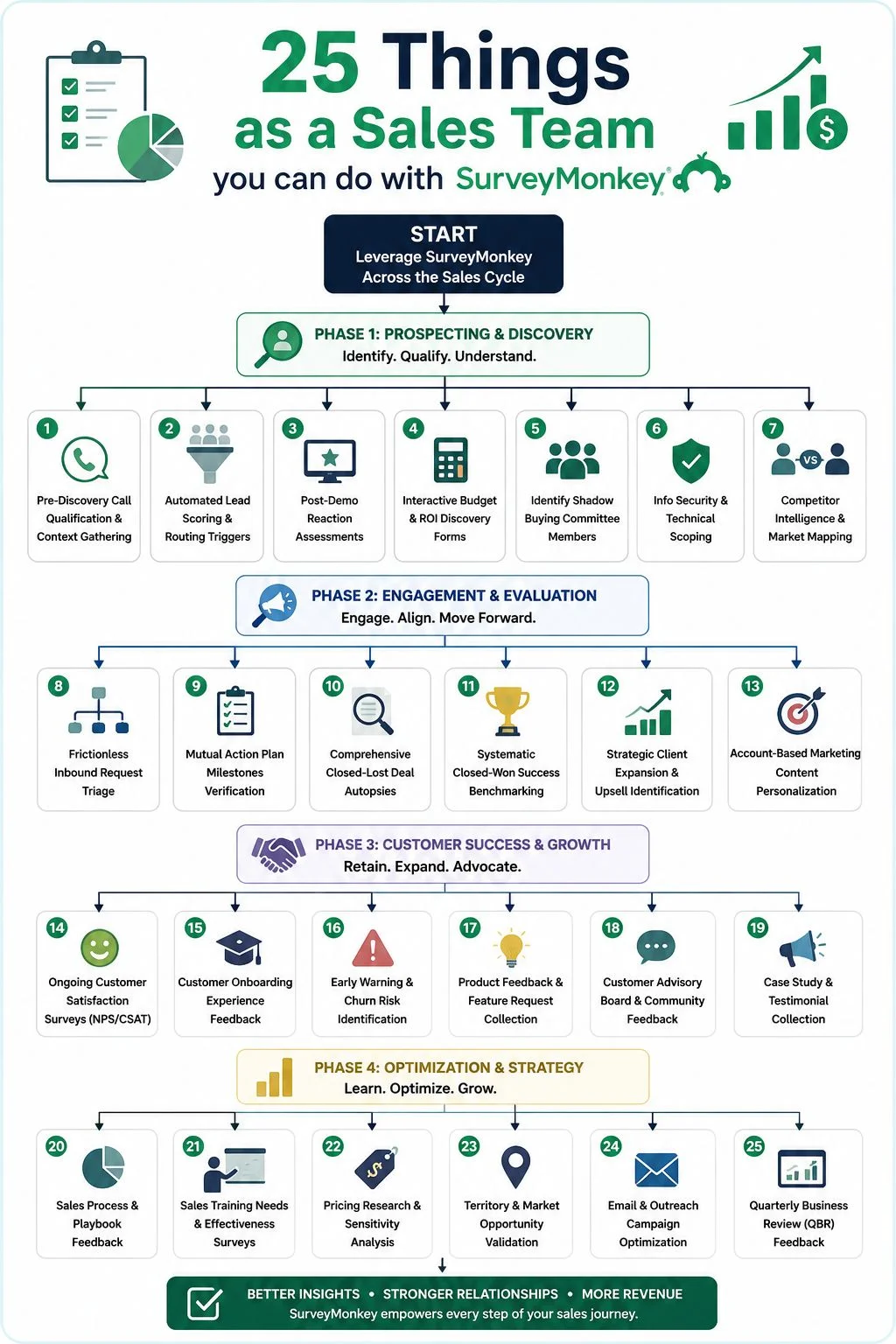
1. Pre-Discovery Call Qualification and Context Gathering
Before our account executives schedule an introductory discovery call, we deploy a targeted four-question pre-call survey. Instead of wasting the initial fifteen minutes of a live meeting establishing basic operational parameters, we collect organizational structure, current tech stack components, and primary pain points in advance. This allows our sales professionals to arrive at the meeting with tailored value propositions and precise industry case studies.
2. Automated Lead Scoring and Routing Triggers
We embed structured SurveyMonkey assessment forms on our high-intent resource pages. By mapping survey responses directly to our customer relationship management system, we assign dynamic numerical lead scores based on budget thresholds, implementation timelines, and authority levels. Highly qualified leads trigger immediate webhook alerts to our outbound sales team, cutting our lead response time from hours to under two minutes.
3. Automated Post-Demo Reaction Assessments
Immediately following a comprehensive product demonstration, we trigger a brief two-minute assessment asking stakeholders to rate product-to-need alignment. This immediate feedback loop identifies hidden reservations regarding specific features, pricing models, or security compliance standards while the demonstration is still fresh in the prospect’s memory.
4. Interactive Budget and ROI Discovery Forms
Rather than directly asking uncomfortable budgetary questions during initial conversations, we send prospects an interactive budget discovery framework. By allowing buyers to select operational ranges, anticipated return-on-investment timelines, and financial authorization levels asynchronously, we eliminate conversational friction and obtain precise financial benchmarks.
5. Identification of Shadow Buying Committee Members
B2B enterprise purchasing decisions rarely involve a single decision-maker. We use surveys to map organizational networks by asking direct points of contact to indicate which additional departments—such as legal, information security, or procurement—must approve the purchase. This early insight prevents deals from stalling during the final contracting phase.
6. Automated Information Security and Technical Scoping
Technical compliance reviews often create significant drag on enterprise sales cycles. We solved this bottleneck by building standardized technical requirements and cybersecurity questionnaires within SurveyMonkey. Prospects forward the link directly to their engineering and compliance leads, allowing our technical sales engineers to review specifications asynchronously.
7. Competitor Intelligence and Market Displacement Mapping
When prospects disclose that they are evaluating alternative platforms, we provide an objective feature prioritization matrix via SurveyMonkey. This allows buyers to rank the product capabilities that matter most to their team. In doing so, we gather critical intelligence on how competitor offerings are perceived and position our unique differentiators accordingly.
8. Frictionless Inbound Request Triage
Standard contact forms often capture insufficient information. We replaced our static landing page forms with branching SurveyMonkey workflows that dynamically tailor questions based on the prospect’s company size, geographic region, and intended deployment scope, ensuring incoming inquiries are properly segmented from day one.
9. Mutual Action Plan Milestones Verification
During complex enterprise negotiations, maintaining momentum requires alignment on joint delivery schedules. We use lightweight survey check-ins at critical milestones to verify that internal prospect stakeholders have fulfilled their mutual action plan responsibilities, such as legal redline completions or executive briefing approvals.
10. Comprehensive Closed-Lost Deal Autopsies
When an opportunity is marked as closed-lost in our CRM, an automated survey is triggered thirty days later to the primary evaluation team. Because the active pressure of the sales process has subsided, former prospects provide honest feedback regarding pricing resistance, competitor feature superiority, or internal rep performance. This data informs our product positioning and ongoing sales training.
11. Systematic Closed-Won Success Benchmarking
Upon executing a contract, we send a brief baseline satisfaction survey to the client’s champion. We capture their exact expectations, stated business metrics, and anticipated outcomes. This establishes baseline operational metrics that our account management and customer success teams use during subsequent quarterly business reviews.
12. Strategic Client Expansion and Upsell Identification
Six months into an active customer contract, we issue satisfaction and product utilization assessments to frontline end-users. When responses demonstrate widespread internal adoption or highlight functional gaps in their current tier, our account executives receive an automated notification signaling an ideal expansion or cross-sell opportunity.
13. Scalable Account-Based Marketing Content Personalization
For our tier-one target accounts, we build customized industry pulse checks. We collect anonymized responses from industry peers, compile the findings into exclusive benchmarking reports, and deliver customized briefings directly to key executives at our target accounts, establishing immediate authority and opening new pipeline conversations.
14. Net Promoter Score Triggers for Referral Generation
We capture Net Promoter Score data at strategic moments across the customer lifecycle. When an enterprise user scores our platform as a nine or ten, the survey completion logic immediately directs them to an advocacy workflow, inviting them to introduce our sales team to other business units or partner organizations.
15. Win-Rate Analysis and Sales Representative Coaching
We systematically evaluate internal sales rep execution by measuring prospect feedback across various communication touchpoints. This objective data helps our sales leadership pinpoint coaching opportunities around active listening, product knowledge depth, and negotiation style.
16. Post-Event Lead Segmentation and Warm Follow-Ups
Following major industry conferences and trade shows, our field sales team deploys personalized surveys within twenty-four hours to all scanned badge contacts. Rather than sending a generic follow-up email, we ask attendees which specific keynote themes and platform features interested them most, enabling segmented and context-aware outbound sequences.
17. Live Webinar Content Customization
During registration for product webinars, we invite attendees to submit their primary technical hurdles through a brief questionnaire. Our sales engineers use these insights to tailor the live presentation in real time, directly addressing the audience’s operational concerns.
18. Customer Advisory Board Candidate Sourcing
Enterprise sales organizations depend on strong customer advisory councils to build long-term relationships with influential buyers. We use annual satisfaction surveys to identify articulate, highly engaged customer leaders and invite them into exclusive executive advisory boards, creating lifelong brand champions.
19. Contract Renewal Sentiment and Risk Monitoring
Ninety days prior to contract expiration dates, we deploy sentiment assessments to enterprise executive sponsors. If dissatisfaction or organizational restructuring is uncovered, our renewal specialists have sufficient lead time to intervene, resolve outstanding service issues, and protect recurring revenue.
20. Pricing Structure and Packaging Elasticity Research
When our leadership considers modifying contract tiers, packaging bundles, or pricing metrics, we survey current and prospective buyers using conjoint analysis questions within SurveyMonkey. This feedback enables us to model price sensitivity and forecast conversion impact prior to implementing changes.
21. Sales Collateral and Content Effectiveness Reviews
Sales teams produce vast libraries of pitch decks, one-pagers, and case studies. We periodically survey our active pipeline prospects to determine which specific assets provided tangible clarity during their decision-making process. Materials that fail to move the needle are rewritten or eliminated.
22. Asynchronous Executive Discovery for Time-Constrained Buyers
C-suite executives rarely have forty-five minutes for preliminary discovery calls. To capture their perspective, we offer a sixty-second executive questionnaire designed for mobile devices. This asynchronous approach captures high-level strategic priorities without demanding calendar commitments.
23. Channel Partner and Reseller Performance Enablement
For organizations with indirect sales channels, maintaining visibility into reseller execution is challenging. We use SurveyMonkey to gather feedback directly from distribution partners regarding co-selling support, portal usability, and deal registration workflows, identifying friction points in our channel strategy.
24. Proof-of-Concept Success Criteria Validation
Before launching technical proofs of concept, we require prospect stakeholders to complete a brief success criteria agreement form. This document formalizes the exact technical and operational metrics that dictate a successful evaluation, preventing scope creep and accelerating the transition to contracting.
25. Voice of Customer Synthesis for Product Roadmap Alignment
Our sales reps continuously hear feature requests and integration requirements. We centralize this prospective customer feedback through internal and external survey mechanisms, feeding structured product demand data directly to our engineering teams to ensure our development roadmap addresses real-world buyer needs.
Frequently Asked Questions
How does using SurveyMonkey improve sales pipeline conversion rates?
SurveyMonkey provides structured, asynchronous discovery data directly from prospects. By uncovering true pain points, decision criteria, and hidden stakeholders before and after calls, sales professionals can tailor their value propositions, address objections early, and shorten the sales cycle.
Can SurveyMonkey integrate directly with our existing CRM?
Yes. SurveyMonkey provides native integrations and webhook configurations for major enterprise CRMs, including Salesforce and HubSpot. Responses, lead scores, and sentiment metrics map directly to lead, contact, and deal records automatically.
What is the ideal survey length for B2B sales prospects?
For pre-call discovery and post-demo assessments, surveys should contain between three and five targeted questions and take no more than two minutes to complete. Keeping forms concise ensures high completion rates among busy professionals.
How do we encourage prospects to complete pre-discovery surveys?
Frame the survey as a tool that respects the prospect’s time. Explain that providing their operational details in advance allows the account executive to skip basic administrative questions and dedicate the entire live conversation to solving their specific challenges.
Can surveys replace traditional sales discovery calls?
Surveys do not replace discovery calls; they enhance them. Surveys handle baseline data collection and technical parameters asynchronously, enabling live discovery conversations to focus on deeper strategic priorities, political dynamics, and business value.
How does SurveyMonkey help identify buying committee members?
By including specific branching questions asking which additional departments—such as legal, information security, or procurement—must approve the purchase, sales reps can identify all stakeholders early in the sales cycle.
When is the best time to send a post-demo feedback survey?
Post-demo surveys should be sent within two to four hours of the presentation’s conclusion while the demonstration, platform capabilities, and initial impressions remain fresh in the prospect’s mind.
How can sales leadership use survey data for coaching?
By aggregating post-meeting and closed-lost survey feedback, sales leaders can identify patterns across individual reps regarding active listening, presentation clarity, objection handling, and pricing negotiation skills.
Is it appropriate to use surveys for enterprise accounts?
Yes. High-level executives often prefer concise, asynchronous digital communication over lengthy administrative calls. Designing mobile-friendly surveys demonstrates that you respect their schedule.
How do closed-lost surveys generate new sales pipeline?
Conducting closed-lost surveys thirty days after a deal ends captures honest feedback on why the deal stalled. These insights allow sales teams to re-engage accounts effectively when internal conditions, budgets, or vendor relationships shift.

Selva Ganesh is a Computer Science Engineer, Android Developer, and Tech Enthusiast. As the Chief Editor of this blog, he brings over 10 years of experience in Android development and professional blogging. He has completed multiple courses under the Google News Initiative, enhancing his expertise in digital journalism and content accuracy. Selva also manages Android Infotech, a globally recognized platform known for its practical, solution-focused articles that help users resolve Android-related issues.




Leave a Reply