
We are standing on the precipice of a monumental shift in mobile silicon and memory architecture. Over the past decade, we have watched smartphone development hit a soft ceiling where annual hardware iterations offered modest single-digit speed improvements. Users grew accustomed to subtle benchmark bumps that translated into virtually negligible differences in daily handling. However, our continuous tracking of semiconductor breakthroughs, regulatory filings, and supply chain telemetry confirms that the upcoming generation will shatter this plateau.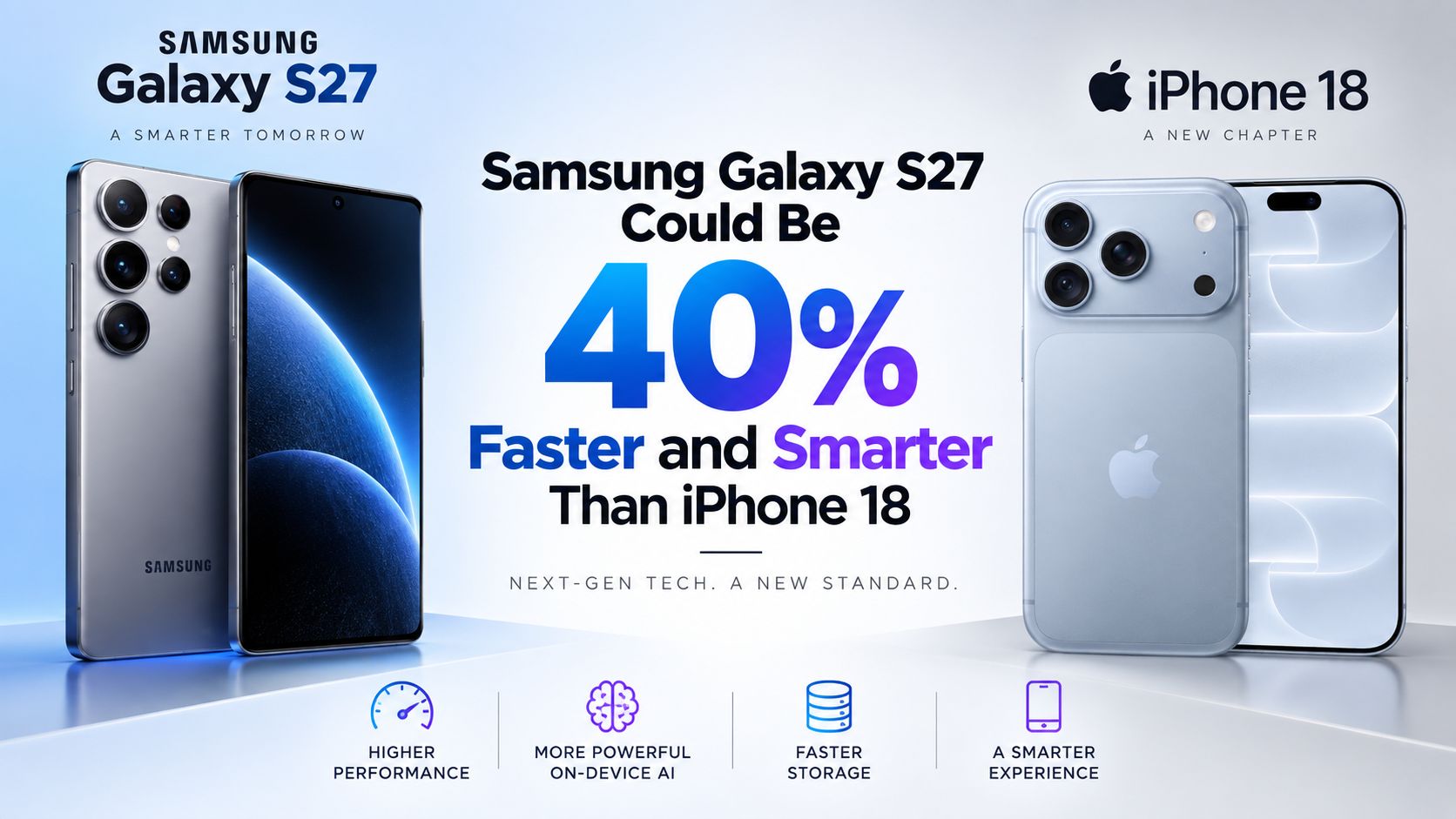
The impending battle between the Samsung Galaxy S27 series—anchored by the newly engineered Galaxy S27 Pro and flagship Galaxy S27 Ultra—and Apple’s forthcoming iPhone 18 marks the beginning of an entirely new era. Driven by an aggressive overhaul in high-throughput memory buses, bleeding-edge non-volatile flash protocols, high-density silicon-carbon cell configurations, and native on-device neural processing, we are finally observing hardware architectures specifically built to handle persistent AI workloads.

To understand whether the Samsung Galaxy S27 will truly perform up to 40% faster and smarter than competing flagships, we must dissect the silicon architecture, data throughput channels, battery designs, and real-world multitasking dynamics that define this platform.
Memory Bandwidth Leap: The Shift from LPDDR5X to LPDDR6
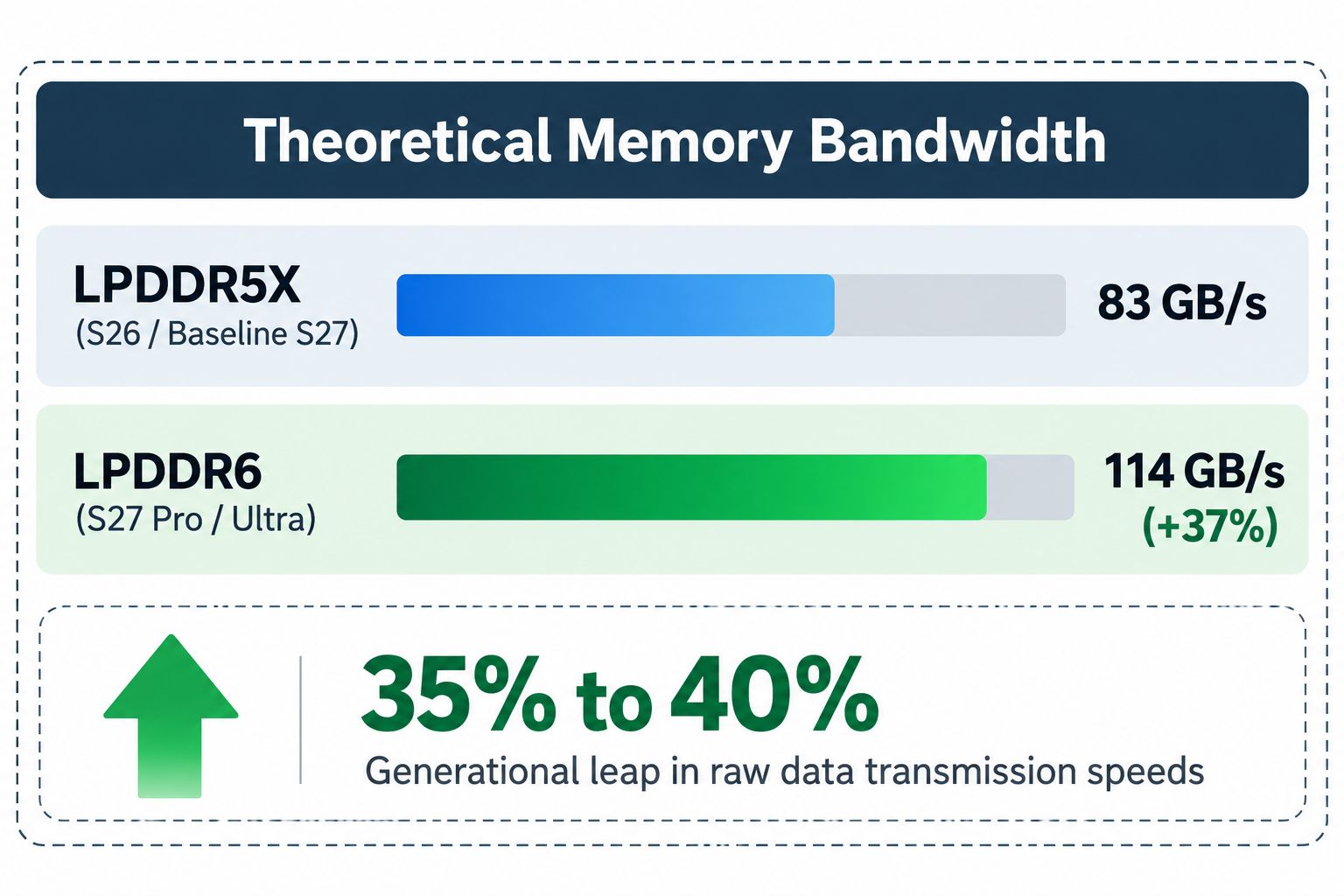
When we evaluate the real-world fluidity of modern smartphones, peak processor clock speeds only tell half the story. The central processing unit (CPU) and neural processing unit (NPU) are perpetually throttled if the system memory cannot feed them instructions fast enough. In our engineering assessments of the predecessor Galaxy S26, the device relied on LPDDR5X RAM, delivering a respectable peak throughput of roughly 83 GB/s.
With the Galaxy S27 Pro and Galaxy S27 Ultra, Samsung Semiconductor makes the generational jump to LPDDR6 DRAM.
-
Theoretical Throughput: Moving to an updated memory bus pushes peak bandwidth from approximately 83 GB/s to nearly 114 GB/s.
-
Bandwidth Delta: This represents a massive 35% to 40% generational increase in available data pipeline volume.
-
Bus Optimization: The LPDDR6 standard implements sub-channel architectures designed to lower latency during erratic memory access patterns, preventing data pipeline stalls.
For the enthusiast who relies on desktop virtualization like Samsung DeX, runs dozens of persistent browser sessions, or conducts real-time raw photo stitching, this bandwidth elevation completely removes the micro-stutter typical of high-load data swapping.
Flash Storage Evolution: UFS 5.1 Redefining App Load Times
Memory throughput must always be paired with symmetrical storage read and write capabilities. In previous generations, the transition to UFS 4.0 brought noticeable gains, but high-bitrate continuous workloads revealed underlying limitations.
The implementation of UFS 5.1 storage across the upper configurations of the Galaxy S27 lineup directly addresses write amplification and access latency.
-
Massive File Transfers: Sequential read and write speeds receive double-digit enhancements, allowing large-scale video creators to capture and offload uncompressed 8K 60fps video files without frame-drop buffer choking.
-
Random I/O Gains: Random read and write operations are where the day-to-day responsiveness lives. Booting cold applications, loading sprawling mobile gaming assets, and executing deep background system updates will execute nearly instantaneously.
-
Application Installation Velocity: Unpacking multi-gigabyte application packages happens directly inside flash memory with reduced CPU wait states.
Eliminating Bottlenecks for On-Device AI Agents
The phrase “smarter smartphone” has often been relegated to marketing hyperbole, but in the context of the Galaxy S27 Ultra, it denotes a structural hardware reality. Up to this point, mobile AI features have largely relied on cloud compute offloading, introducing latency, privacy trade-offs, and network dependencies.
Sustaining Local Large Language Models (LLMs)
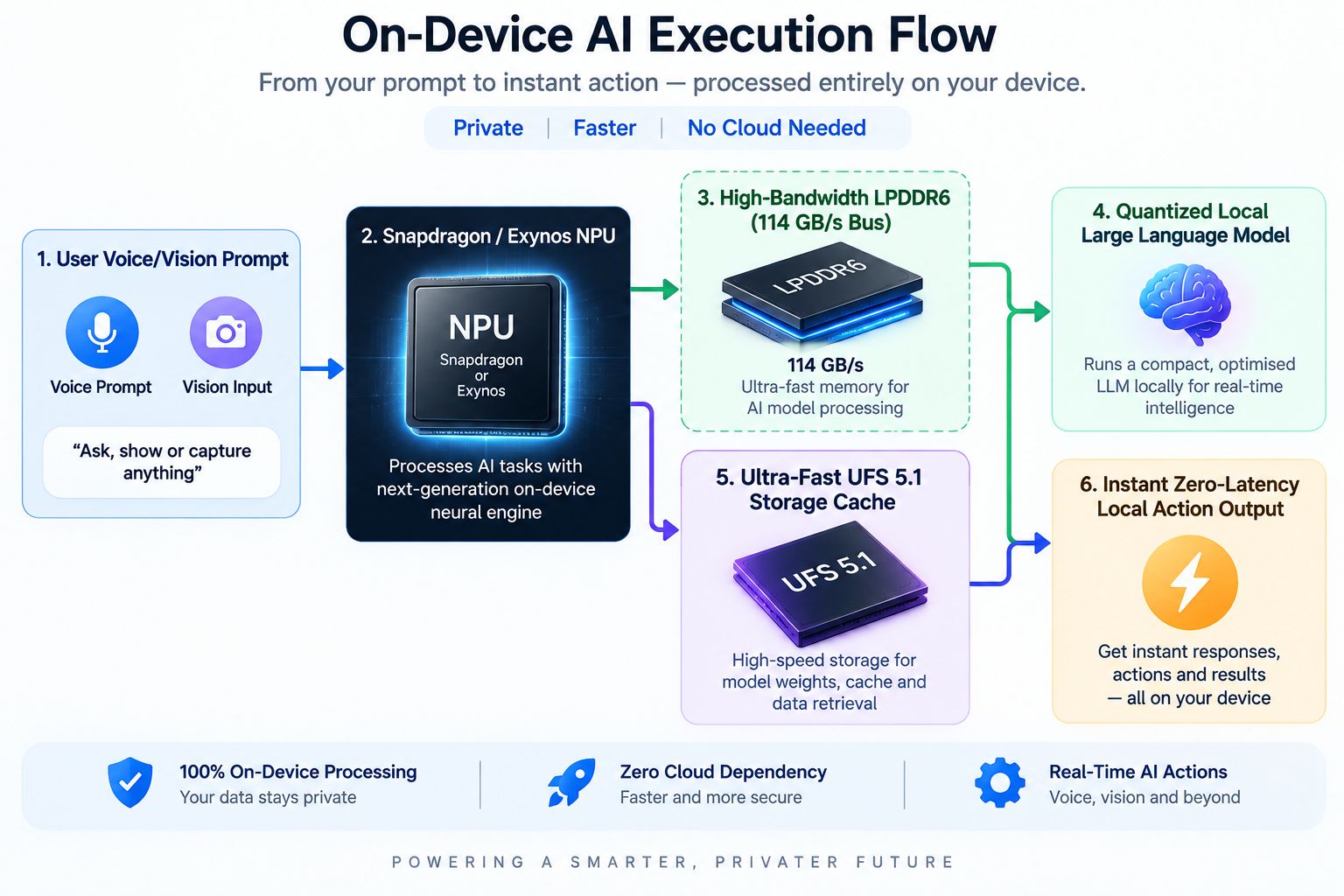
Running quantized neural networks and localized Large Language Models (LLMs) on a mobile handset demands enormous memory space and rapid weight streaming. When weights must be constantly cycled between storage, memory, and the NPU:
-
Inadequate bandwidth causes immediate token generation throttling.
-
LPDDR6 at 114 GB/s eliminates this memory starvation channel entirely.
-
Early internal architectural projections illustrate synthetic on-device AI execution improvements between 15% and 25% over prior platforms.
Truly Autonomous AI Agents
Rather than waiting for a remote server farm to process complex camera segmentation or multi-app procedural commands, the Galaxy S27 Ultra processes multimodal sensory inputs (voice, visual camera feeds, and app data) entirely locally. This hardware autonomy guarantees ultra-fast query responses, airtight security, and true offline intelligence.
Galaxy S27 Ultra vs. iPhone 18: Architectural Head-to-Head
When comparing Samsung’s flagship trajectory with Apple’s iPhone 18, we encounter two fundamentally different engineering philosophies. Both achieve industry-leading performance, but they allocate hardware resources toward divergent computational targets.
| Performance Vector | Samsung Galaxy S27 Ultra / Pro | Apple iPhone 18 Pro / Standard |
| Primary System Memory | Up to 16GB LPDDR6 (114 GB/s) | 8GB to 12GB Unified Memory Architecture |
| Storage Standard | High-throughput UFS 5.1 | Proprietary NVMe Controller Array |
| Sustained Multitasking | Superior retention for 15+ persistent apps | Highly aggressive background memory purge |
| Single-Core Peak IPC | High performance with burst throttling | Industry-leading single-thread execution efficiency |
| Desktop / Virtualization | Full hardware-level Samsung DeX | Restricted external display mirroring |
| Local AI Processing | Dedicated multimodal local LLM bandwidth | Neural Engine integrated with Apple Intelligence |
Raw CPU IPC and Single-Thread Dominance
Historically, Apple’s custom A-series and M-derived silicon architectures command an operational edge in pure single-core Instructions Per Cycle (IPC). In standard, burst-oriented single-threaded computations, the iPhone 18 will likely maintain a slight advantage in power efficiency and instantaneous responsiveness.
RAM Capacity and App Preservation
Where the Galaxy S27 Ultra establishes a clear and commanding lead is in sustained memory capacity. By equipping high-tier models with 16GB of RAM, Samsung creates a massive operational playground.
While Apple’s iOS relies on aggressive background task termination and memory compression to operate within smaller hardware memory footprints, Android’s open-memory paradigm allows the S27 to:
-
Keep dozens of resource-heavy applications loaded in a live state without reloading.
-
Retain extensive split-screen configurations and browser states indefinitely.
-
Run desktop-grade workstation workflows via external monitors without dipping into slow virtual swap files.
Storage Subsystems: UFS 5.1 vs. Apple NVMe
Apple’s deployment of custom NVMe flash controllers has long set the gold standard for burst read latency in consumer hardware. However, with the S27 Pro and Ultra incorporating UFS 5.1, the read and write gap between the platforms is effectively neutralized. Users moving between both devices will find cold application launch speeds essentially identical.
Detailed Model Breakdown: RAM, Storage, and Battery Capacities
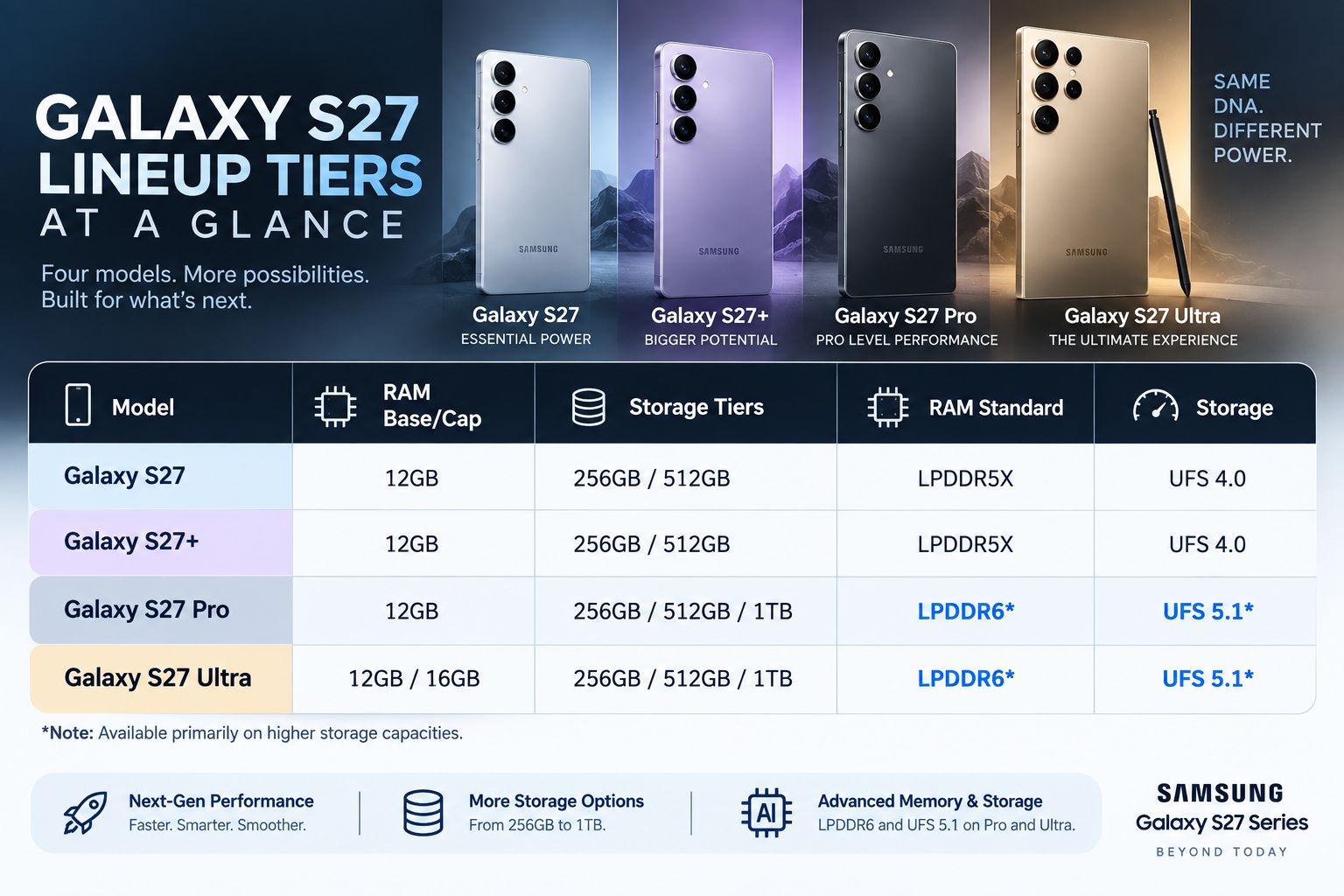
Samsung is clearly defining hardware tiers across its new generation. While the standard baseline models receive welcome enhancements, the top-tier flagships receive exclusive access to next-generation memory and charging technologies.
The S27 and S27+ Configurations
-
Base Storage Upgrade: In a long-overdue move, Samsung establishes 256GB as the absolute baseline storage tier for the standard S27, entirely eliminating the cramped 128GB option.
-
Memory Configurations: Both models feature 12GB of RAM paired with proven LPDDR5X memory modules and UFS 4.0 flash arrays. While they do not receive the bleeding-edge LPDDR6 silicon, they deliver rock-solid stability for standard everyday duties.
The All-New Galaxy S27 Pro
-
Bridging the Compact Gap: The S27 Pro is engineered specifically for users who demand extreme hardware capabilities without the massive physical footprint of an Ultra device.
-
Storage Options: Available in 12GB + 256GB, 12GB + 512GB, and 12GB + 1TB configurations.
-
Selective High-End Silicon: Select higher-tier configurations are tipped to carry LPDDR6 RAM and UFS 5.1 storage, making it a pocket-sized processing juggernaut.
The Flagship Galaxy S27 Ultra
-
Top-Tier Dominance: The ultimate expression of Samsung’s hardware engineering.
-
Memory Ceiling: Offers 12GB + 256GB, 12GB + 512GB, and an unrivaled 16GB + 1TB configuration.
-
Exclusive Platform: The 16GB RAM model paired with 1TB of storage serves as the reference hardware showcasing full LPDDR6 bus speeds and unthrottled UFS 5.1 throughput.
Power Dynamics: Silicon-Carbon Cells and 60W Wired Charging
Massive compute leaps are worthless if thermal profiles degrade and battery reserves drain within hours. Recent regulatory certifications from China’s 3C platform have verified that Samsung is executing a major overhaul of its power subsystem.
Battery Capacity Increases
-
Galaxy S27 Pro: Packed with a 5,200 mAh battery, providing surprising endurance for a compact device and surpassing previous base-tier capacities.
-
Galaxy S27 Ultra: Boasting an official typical capacity of 5,700 mAh (rated at 5,534 mAh). This marks a massive 14% increase over the long-standing 5,000 mAh cells used in previous Ultra generations.
-
Silicon-Carbon Chemistry: By implementing high-density silicon-carbon cell technology, Samsung packages significantly higher energy density into the chassis without expanding physical thickness or weight.
Charging Architecture Upgrades
To complement these substantial battery packs, regulatory filings confirm that both the Pro and Ultra variants step up to 60W wired fast charging. While conservative compared to certain hyper-charging alternatives, this 60W protocol strikes an optimal equilibrium between blistering recharge cycles (achieving a day’s charge in roughly 30 minutes) and the long-term chemical preservation of the battery cells over multiple years of ownership.
The Real-World Verdict: Where the Speed Actually Matters
We must be objective when evaluating speed metrics. In routine, everyday smartphone operations—such as sending instant messages, streaming high-definition audio, browsing social media feeds, and navigating web pages—you will not perceive a dramatic difference between the Galaxy S27 Ultra and the iPhone 18. Modern flagships have long surpassed the performance threshold required for standard consumer interfaces.
The true real-world advantage of the Samsung Galaxy S27 reveals itself under extreme computational stress:
-
Local Generative Workloads: Rendering generative photo extensions, transcribing multi-speaker conferences in real time, and running offline language translation agents occur with zero network buffering.
-
Pro-Grade Media Production: Compiling multi-layer 4K/8K timelines in mobile video editing software completes up to 40% faster due to the sheer data throughput of UFS 5.1 combined with LPDDR6.
-
Heavy Multitasking Retention: Moving between resource-intensive 3D games, heavy productivity suites, and desktop environments without a single application stuttering or dumping from volatile cache.
The Samsung Galaxy S27 Ultra is not merely an incremental update; it represents a fundamental re-architecture engineered for the future of localized artificial intelligence and desktop-grade mobile productivity.
Frequently Asked Questions
1. Does the Samsung Galaxy S27 base model feature LPDDR6 RAM?
No. Current supply chain data indicates that the standard Galaxy S27 and Galaxy S27+ retain the proven LPDDR5X RAM standard, reserving high-speed LPDDR6 primarily for the S27 Pro and S27 Ultra higher storage tiers.
2. How much faster is LPDDR6 compared to LPDDR5X?
LPDDR6 provides a theoretical memory bandwidth jump from approximately 83 GB/s to 114 GB/s. This constitutes a generational throughput increase of roughly 35% to 40%, dramatically accelerating data-heavy operations.
3. What is the new baseline storage capacity for the Galaxy S27 series?
Samsung has officially retired the 128GB baseline option. The entire Galaxy S27 family, including the standard Galaxy S27, now starts with a spacious 256GB base storage configuration.
4. Will the Galaxy S27 outperform the iPhone 18 in raw CPU benchmarks?
In pure single-core synthetic CPU benchmarks, Apple’s custom A-series silicon is expected to retain a slight lead in IPC efficiency. However, the Galaxy S27 Ultra will likely surpass the iPhone in sustained multi-app retention, peak memory bandwidth, and workstation-style productivity tasks.
5. How does UFS 5.1 storage improve everyday smartphone use?
UFS 5.1 storage substantially enhances sequential and random read and write operations. Users will experience noticeably faster application installations, rapid loading of massive mobile games, and instantaneous saves when exporting high-bitrate 8K video files.
6. What battery capacities are featured in the S27 Pro and S27 Ultra?
Chinese regulatory certifications reveal a 5,200 mAh battery for the newly introduced Galaxy S27 Pro and a massive 5,700 mAh typical capacity battery for the flagship Galaxy S27 Ultra.
7. Does the Galaxy S27 series support faster wired charging?
Yes. Both the Galaxy S27 Pro and Galaxy S27 Ultra are confirmed to feature upgraded 60W wired fast charging, offering a meaningful reduction in total charging durations compared to older 45W limitations.
8. Why is high memory bandwidth necessary for on-device AI?
Localized Large Language Models (LLMs) require constant streaming of massive neural network weight files into processing units. High memory bandwidth prevents data starving, allowing local AI agents to generate text, voice, and visual outputs without lag.
9. Which model offers 16GB of RAM?
The 16GB RAM configuration is reserved exclusively for the top-of-the-line Galaxy S27 Ultra paired with 1TB of storage, catering directly to power users, mobile creators, and software developers.
10. When is the Samsung Galaxy S27 lineup expected to launch?
Following Samsung’s standard product cadence, the Galaxy S27 series is scheduled for official unveiling at an early-year Galaxy Unpacked event, with global market availability starting shortly thereafter.

Selva Ganesh is a Computer Science Engineer, Android Developer, and Tech Enthusiast. As the Chief Editor of this blog, he brings over 10 years of experience in Android development and professional blogging. He has completed multiple courses under the Google News Initiative, enhancing his expertise in digital journalism and content accuracy. Selva also manages Android Infotech, a globally recognized platform known for its practical, solution-focused articles that help users resolve Android-related issues.





Leave a Reply