
The Hidden Catch in Siri AI’s Massive Privacy Upgrade – The modern digital landscape is witnessing a dramatic transformation in how everyday artificial intelligence interacts with our most sensitive personal information. With Apple’s latest introduction of a profoundly more capable and personal Siri AI system architecture, hundreds of millions of smartphone, tablet, and computer users are on the verge of experiencing an unprecedented level of device automation.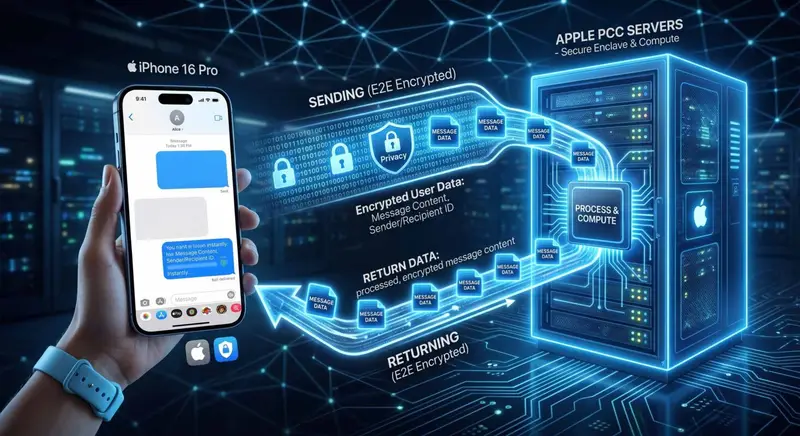
We are moving rapidly away from the old era of simple voice commands and static question-and-answer interactions. Apple is introducing a fundamentally rebuilt digital companion that features system-wide integration, on-screen awareness, and deep personal context understanding. This upgraded version of Siri can actively scan your text messages, read your emails, analyze your calendar schedules, index your photo libraries, and monitor exactly what is happening on your device’s screen in real time.

While the immense marketing focus highlights the sheer convenience of an assistant that truly understands your life, a critical, hidden trade-off deserves intense scrutiny. For everyday consumers who do not understand advanced technology, this evolution introduces a massive shift in how private data is tracked, managed, and processed. We must evaluate the true reality beneath the sleek promotional promises: What happens to our privacy when an artificial intelligence is given total, unfettered access to map out our digital lives?
Defining Apple’s Shift to Context-Aware AI Assistance
To properly dissect the underlying concerns of this monumental upgrade, we must first look at what makes this new Siri AI architecture vastly different from the classic assistant we have used for over a decade. Historically, digital assistants operated on a strict, transactional basis. You provided a specific voice command—such as asking for the weather forecast, requesting a hands-free timer, or playing a song playlist—and the software performed a isolated lookup to deliver an immediate answer. The application held no long-term memory of your previous sentences, possessed no contextual awareness of your daily routine, and remained completely blind to the visual contents displayed on your screen.
The newly deployed framework relies entirely on a continuous background operation known as personal context indexing. Instead of waiting passively for you to wake it up, the system constantly monitors the data moving across your device to construct a dense, deeply connected map of your personal history.
This means the assistant is actively reading your incoming emails for flight receipts, tracking your instant messages for dinner invitations, parsing your photos to recognize your family members, and observing the exact document or webpage currently open under your thumbs. When you ask a question, the software does not just search the public web; it sifts through your personal life history to generate a tailored response.
This comprehensive approach allows the assistant to execute complex, multi-app operations on your behalf. It can automatically look up a flight confirmation number buried deep within an old text thread, cross-reference it with real-time flight delays, and update your calendar—all while simultaneously drafting an email response to a colleague using your unique writing style. However, achieving this seamless user experience introduces a stark structural reality: the assistant must be granted open eyes over every single file stored on your hardware.
The Core Dilemma: Local Processing vs. Cloud Scaling
The primary pillar used to assure consumers about data safety is the heavy emphasis on on-device processing. Tech companies consistently highlight that the vast majority of these personal data calculations happen directly on the local computer chips powering your individual iPhone, iPad, or Mac. Because the raw data does not leave your physical possession, it is theoretically safe from data breaches, corporate mining, or cloud interception.
The hidden catch manifests because consumer mobile devices have hard computational limitations. True artificial intelligence reasoning, sorting through years of unorganized conversations, and generating intricate images or text summaries require immense amount of computing muscle. When a user issues a complex or multi-layered command that exceeds the threshold of a phone’s internal processor, the operating system must look beyond the physical device to find the necessary computing power.
To bridge this gap without visibly breaking privacy rules, a multi-tier infrastructure has been deployed:
- On-Device Silicon Engines: The local hardware chip serves as the first line of defense, executing everyday text tasks, basic searches, and direct app actions entirely offline.
- Private Cloud Compute (PCC): When a request demands advanced mathematical reasoning, the device encrypts a specific package of your personal data and transmits it to highly secure, dedicated cloud servers. These specialized servers are designed to process your data on the fly without ever storing a permanent profile or allowing human administrators to view the contents.
- Third-Party Model Integration: For vast queries requiring broad world knowledge or creative writing, the interface provides seamless bridges to external, third-party models like OpenAI’s ChatGPT or Google’s Gemini, passing your queries outward if you grant permission.
Even with advanced encryption safeguards in place, the core privacy paradigm changes fundamentally the moment your private emails, personal photos, and real-time screen contents must leave your hand to be sorted on a remote server array.
Mapping the Personal Data Pipeline
When you prompt the upgraded assistant to help you with an action on your screen, a complex data journey takes place across multiple processing layers within fractions of a second. Understanding this sequence highlights exactly how your data moves from your hand to the cloud.
1. Screen Content Capture: Local Level.
The assistant utilizes its advanced on-screen awareness to read and parse the text, images, or code currently visible on your display, identifying relevant names, dates, or items.
2. Context Compilation: Local Level.
The operating system scans your internal personal index, compiling a hidden package of background data—such as your current location, recent messages, and calendar entries—to give your request full context.
3. Hardware Triage Assessment: Triage Level.
The internal chip measures the computational weight of the task. If the query requires advanced language processing or external information, the phone prepares the context package for secure export.
4. Cloud Routing and Computation: External Level.
The encrypted data package is transmitted over the internet to a secure server network. If an external partner model is selected, the query details are pushed to an outside cloud to generate the final response before sending it back to your device screen.
Why Non-Technical Users Must Pay Close Attention
For the vast majority of ordinary smartphone owners, advanced industry catchphrases like “end-to-end encryption,” “secure enclaves,” or “cryptographic verification” sound like guarantees of perfect safety. The simpler, unvarnished reality is that your personal electronics are no longer acting as passive digital vaults meant to store your files securely; they have been converted into active readers that must constantly analyze those files to remain helpful.
Consider a practical, real-world example of how this alters daily privacy:
The Old Paradigm: If a family member sends you a highly sensitive text message containing private medical diagnoses, financial details, or home security passcodes, that text message sits silently in your inbox as raw, unread text until you choose to open it.
The New Paradigm: The modern assistant reads that incoming message instantly, indexes the underlying meaning, and ties that sensitive data to your calendar, your map locations, and your contact cards. If you open a banking app, the on-screen awareness records the context of what you are viewing to anticipate your next move.
The true hidden catch for non-technical users is not a traditional, malicious data hack or a catastrophic corporate leak. The primary concern is the quiet normalization of continuous surveillance by your own personal devices. When an AI ecosystem is constantly analyzing your screen to help you compose email drafts or organize travel itineraries, you surrender the ability to maintain a truly isolated, unmonitored digital lifestyle.
Global Regulatory Resistance and Geographic Fragmentation
The complications surrounding this incredibly deep level of data access are already causing massive friction on the world stage. Because this AI architecture requires systemic permissions to read across independent apps and bridge local data with cloud infrastructure, international regulatory agencies are actively stepping in to slow down or block its implementation.
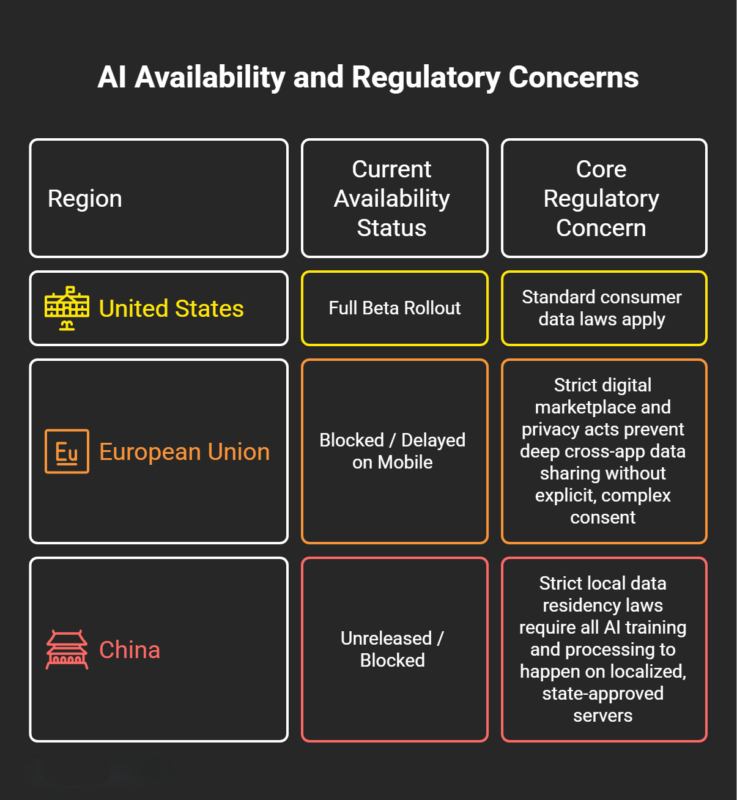
This growing geographic divide serves as proof that the hidden catch is not merely a theoretical debate for privacy advocates. Global governments recognize that allowing an operating system to systematically index, cross-reference, and securely export an individual’s entire personal history changes the balance of consumer privacy permanently.
Striking the Balance Between Automation and Control
The technological industry argues with conviction that this profound level of tracking is the mandatory entry price for the next generation of artificial intelligence. If you desire an assistant capable of finding a specific photo of a pet from years ago based on a vague, casual description, or an assistant that can write complicated emails in your exact voice, the software cannot remain blind. It must be granted the keys to view your information.
For every individual user, the ultimate test moving forward will be managing the balance between convenience and control. The operating systems of tomorrow will undeniably offer incredible, time-saving capabilities. Still, they demand that you dissolve the boundary between your local offline files and the cloud networks that make advanced reasoning possible. Acknowledging that your digital assistant is actively reading your screen is the critical first step in deciding exactly how much of your private life you are willing to trade for the promise of total automation.
We must remember that the evolution of context-driven personal intelligence represents an irreversible turning point in modern computing. As these integrated tools quickly become the default standard on our primary communication devices, staying vigilant about where on-device privacy ends and server cloud computation begins remains an essential duty for all contemporary technology consumers.

Selva Ganesh is a Computer Science Engineer, Android Developer, and Tech Enthusiast. As the Chief Editor of this blog, he brings over 10 years of experience in Android development and professional blogging. He has completed multiple courses under the Google News Initiative, enhancing his expertise in digital journalism and content accuracy. Selva also manages Android Infotech, a globally recognized platform known for its practical, solution-focused articles that help users resolve Android-related issues.





Leave a Reply