
What Google Gemini Models Are Available with Free, Plus & Pro Plans? Google Gemini powers modern digital workflows by transforming how individuals and teams interact with artificial intelligence, scaling from lightweight everyday queries to advanced creative and analytical reasoning. Navigating the digital assistant ecosystem requires understanding how Google structures its service across multiple access levels. These options include a zero-cost baseline tier and specialized paid subscriptions such as Google AI Plus, Google AI Pro, and Google AI Ultra.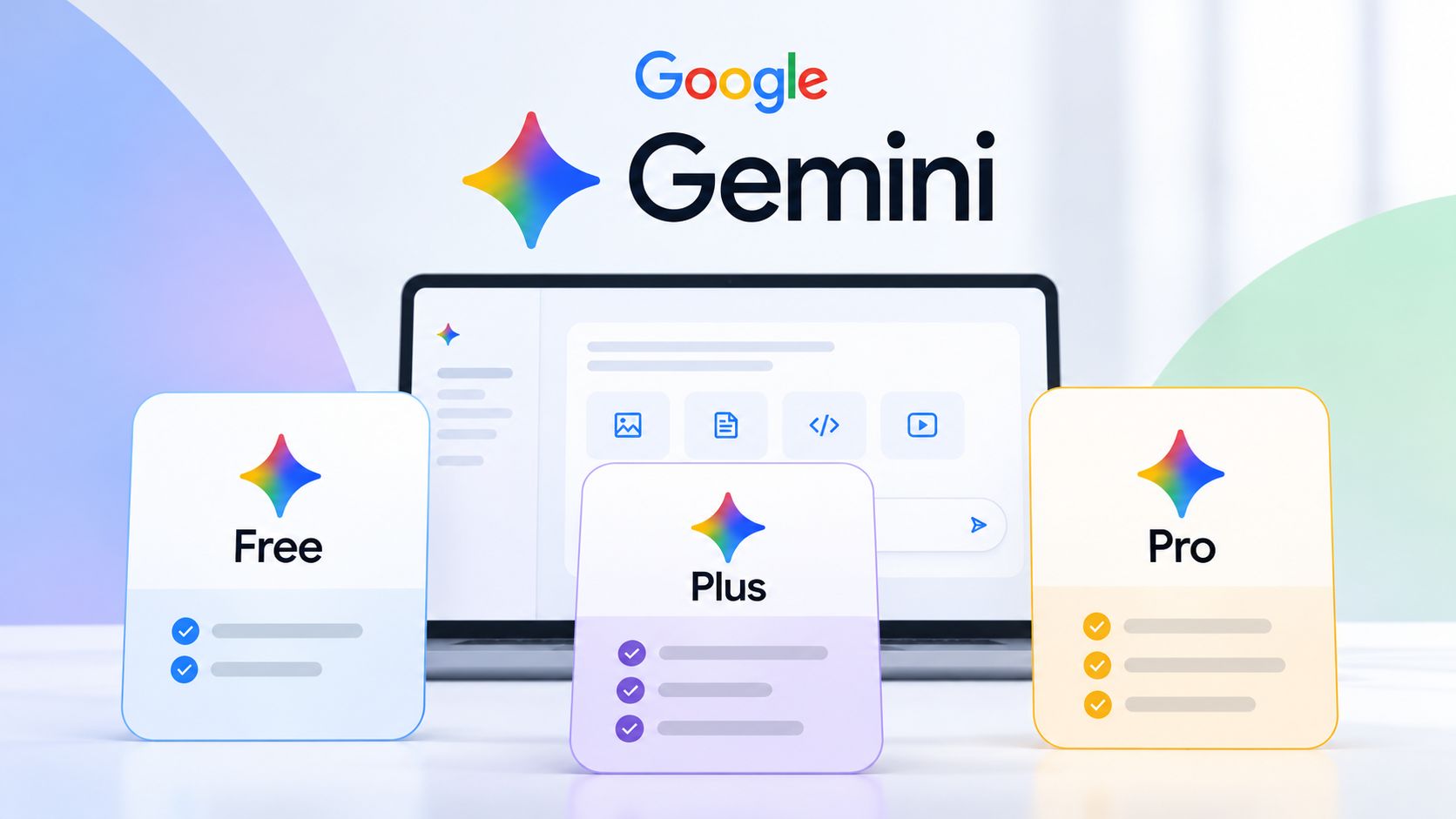
Choosing the right subscription level ensures you receive the correct compute capacity, cloud storage allowance, and model intelligence for your daily routine. Whether you manage complex programming tasks, draft professional communications, study dense academic research, or brainstorm creative projects, understanding these tier differences helps you maximize your productivity.

Understanding the Google Gemini Access Tiers
The ecosystem is structured around compute tiers designed to match varying workloads and professional requirements.
The Free Tier
The baseline tier provides open access to foundational artificial intelligence capabilities without requiring any financial commitment. Operating with a personal Google Account, this tier utilizes efficient models like Flash-Lite and Flash to deliver rapid answers for general tasks.
-
Core Capabilities: Handles everyday writing assistance, basic brainstorming, standard document summarization, and prompt-based image creation.
-
Storage and Limits: Relies on the standard 15 GB of cloud storage shared across Gmail, Google Drive, and Google Photos. Usage operates under dynamic compute windows that refresh every five hours.
-
Best Suited For: Casual users, students, and individuals exploring AI tools for light day-to-day writing and quick questions.
Google AI Plus
Positioned as an accessible entry point for heavier daily productivity, the Plus tier expands capabilities and elevates resource limits.
-
Core Capabilities: Delivers double the usage volume of the free tier, broader integration with Google Workspace tools, and enhanced access to creative generation models.
-
Storage and Limits: Provides 400 GB of pooled cloud storage with family sharing options for up to five additional users.
-
Best Suited For: Freelancers and power users who need higher daily message caps and moderate cloud storage without stepping up to professional enterprise tiers.
Google AI Pro
Designed for professionals, researchers, and developers, the Pro tier unlocks advanced reasoning models and extensive integration within productivity suites.
-
Core Capabilities: Grants access to flagship reasoning architectures (such as Gemini Pro variants), Deep Research features, and automated browser tasks. It also enables deep Workspace integrations for Gmail, Google Docs, and Sheets.
-
Storage and Limits: Multiplies standard compute limits significantly and includes 5 TB of cloud storage.
-
Best Suited For: Knowledge workers, software engineers, and digital practitioners handling dense datasets, complex coding workflows, and multi-file document analysis.
Google AI Ultra
Built for power users and enterprise-level demands, Ultra represents the pinnacle of consumer and professional access.
-
Core Capabilities: Offers the highest available compute multipliers, advanced agentic capabilities, specialized developer integrations, and priority execution on resource-intensive operations.
-
Storage and Limits: Delivers expansive cloud storage scaling upward from 20 TB, alongside the highest tier limits for API tools and development assistants.
-
Best Suited For: Organizations, heavy technical developers, and power users requiring uninterrupted, top-tier computational access.
Comparison of Access Tiers
| Feature / Metric | Free Tier | Google AI Plus | Google AI Pro | Google AI Ultra |
| Monthly Cost | $0 | $4.99 | $19.99 | $99.99 – $199.99 |
| Primary Models | Flash-Lite & Flash | Flash & Standard Models | Pro & Frontier Models | Highest-Tier Frontier Models |
| Cloud Storage | 15 GB | 400 GB | 5 TB | 20 TB+ |
| Workspace Integration | Basic web access | Enhanced writing tools | Deep Docs & Sheets integration | Maximum limits across all apps |
| Research Tools | Standard search | Standard search | Deep Research access | Highest priority Deep Research |
1. Free Tier
-
Primary Models: Gemini 3.5 Flash-Lite and Gemini 3.8 Flash (with standard rate limiting)
-
What this means: The free tier balances speed and accessibility by using Google’s efficient workhorse models. For everyday conversational queries, quick lookups, and basic drafting, the system routes traffic through Gemini 3.5 Flash-Lite for ultra-fast, high-volume tasks, while utilizing Gemini 3.8 Flash for general multimodality and prompt-based text-and-image generation.
2. Google AI Plus
-
Primary Models: Gemini 3.8 Flash and Gemini 3.6 Flash
-
What this means: Paid entry users step up to dedicated allocations of Google’s advanced Flash models. These models provide robust reasoning capabilities, large context windows (supporting up to 1 million tokens for multi-file analysis), and improved code-generation stability compared to the free baseline, with significantly higher message caps before hitting rolling window limits.
3. Google AI Pro
-
Primary Models: Gemini 3.1 Pro and Gemini 3.7 / 3.8 Flash (with expanded Deep Research capabilities)
-
What this means: The Pro tier unlocks heavy-duty reasoning architectures. Gemini 3.1 Pro serves as the primary engine for complex logic, multi-step agentic workflows, dense codebase refactoring, and deep document reasoning. Subscribers also gain access to specialized research capabilities that execute multi-step web searches and autonomous synthesis.
4. Google AI Ultra
-
Primary Models: Gemini 4 Argon and Gemini 3.1 Pro (running with maximum priority and agentic extensions)
-
What this means: Positioned at the apex of Google’s consumer and developer access, the Ultra tier routes complex tasks to Gemini 4 Argon. Released as Google’s flagship frontier model, Argon excels at deep work across complex real-world domains—including advanced coding, financial modeling, scientific data extraction, and cybersecurity analysis—while providing maximum output token limits and priority execution.
Practical Selection Considerations
Selecting the ideal tier depends entirely on your daily operational bottleneck. If you primarily rely on conversational queries, basic proofreading, and quick lookups, the Free tier provides ample utility without financial overhead.
However, professionals managing large local file repositories, extensive video analysis, or automated code review will quickly benefit from the expanded compute quotas and massive storage capacity found in the Pro and Ultra tiers. Evaluating your typical daily prompt volume and cloud storage requirements ensures your subscription matches your exact production workflow.
Frequently Asked Questions
1. Can I switch between subscription tiers at any time?
Yes, you can upgrade, downgrade, or cancel your subscription level through your Google account settings whenever your project requirements change.
2. Does the Free tier require a credit card to get started?
No, the baseline Free tier requires only a personal Google Account and involves zero financial transactions.
3. How often do usage limits reset on paid plans?
Compute-based limits operate on a rolling window that refreshes every five hours, subject to overall weekly caps depending on your plan tier.
4. Are my prompt inputs used to train Google models on paid plans?
Paid subscription data is handled with enhanced privacy standards and is not used to train Google generative models, unlike standard free tier usage.
5. What happens when I reach my compute limit?
When usage limits are temporarily exhausted, prompts may be redirected to lighter model variants or experience temporary throttling until the rolling window refreshes.
6. Do student discounts apply to Google AI subscriptions?
Eligible students in qualifying regions can access promotional trial periods for intermediate subscription tiers through authorized verification partners.
7. How does cloud storage scale across these plans?
Storage allocations scale directly with your subscription tier, ranging from the standard 15 GB up to multi-terabyte pools shared across Drive, Gmail, and Photos.
8. Can multiple family members share a paid plan’s storage?
Plans such as Google AI Plus and higher support family sharing allowances, permitting multiple accounts to share the designated cloud storage pool.
9. Which model tier supports deep multi-file document analysis?
Comprehensive analysis of large documents, extensive spreadsheets, and large code repositories requires the higher context windows and processing power of Pro or Ultra tiers.
10. Are API services billed under the same rules as consumer subscriptions?
Developer API usage operates on distinct token-based billing structures and rate limits separate from consumer-facing monthly web subscriptions.

Selva Ganesh is a Computer Science Engineer, Android Developer, and Tech Enthusiast. As the Chief Editor of this blog, he brings over 10 years of experience in Android development and professional blogging. He has completed multiple courses under the Google News Initiative, enhancing his expertise in digital journalism and content accuracy. Selva also manages Android Infotech, a globally recognized platform known for its practical, solution-focused articles that help users resolve Android-related issues.




Writing and brainstorming are deeply personal, but AI makes a wonderful collaborative partner. Understanding the plan structures helps writers pick their ideal digital assistant.
Crossing boundaries in digital productivity requires reliable infrastructure. The tiered Gemini ecosystem offers a solid foundation for both individuals and teams.
Technology can be wonderfully quirky, especially when you are just playing around with free AI prompts. When you need serious work done, though, the paid tiers are necessary.
In a world dominated by rapidly advancing technology, keeping track of AI tiers is survival. This guide provides a very clear roadmap of the Gemini landscape.
Complex dramatic projects and script analysis demand high-tier AI assistance. It is great to see Google offering specialized paths for intensive creative labor.
For every action in a digital workflow, there is an equal and opposite AI reaction. Choosing the correct Gemini tier optimizes that equation perfectly.
Nuanced analysis requires tools that can think beyond simple keyword matching. The advanced reasoning capabilities mentioned here are crucial for deep research.
An insightful and sophisticated look at modern artificial intelligence integration. Professionals must understand these subscription levels to stay competitive.
Budgeting for software subscriptions is tough, so knowing the exact value of each tier matters. The free option is a lifesaver for tight budgets.
The flexibility of scaling from lightweight queries to advanced reasoning is my favorite feature. Google has built a very comprehensive assistant ecosystem here.
Truth and clarity are essential when evaluating software ecosystems. This review cuts through the marketing noise to explain the actual utility of each Gemini tier.
Thor’s hammer has nothing on the processing power of an advanced AI model! Jokes aside, the Gemini Pro tier sounds like a beast for heavy workloads.
Social media management and content creation are so much smoother with AI assistance. Breaking down the plans like this helps influencers choose the best tool.
In politics and business, timing and information processing are everything. Utilizing the right Gemini subscription tier can significantly sharpen decision-making.
Visual storytelling and massive creative projects require heavy-duty AI processing power. The higher-tier Gemini plans look promising for ambitious multimedia workflows.
Youth and student demographics benefit immensely from the zero-cost baseline tier. As our careers advance, transitioning to Plus or Pro makes total sense.
Conquering complex digital workflows is much easier with the right AI companion. The tiered approach ensures users are well-equipped for any analytical battle.
Chemistry simulations and complex data parsing require advanced reasoning models. Google structuring Gemini this way makes it easier to select the right tool for rigorous science.
Design and analytical workflows demand precise and rapid AI responses. The Pro and Ultra subscriptions seem tailored precisely for high-demand professional environments.
Strategic deployment of AI tools can give teams a massive competitive edge. Understanding the hierarchy of Google AI plans is the first step toward effective implementation.