
Samsung Galaxy S27 3D Render Camera Redesign Leaked– Every few product cycles, smartphone hardware reaches an evolutionary crossroads where aesthetic continuity must yield to functional engineering. For years, we have grown accustomed to the signature floating lens aesthetic that defined the flagship Galaxy experience. That minimalist silhouette, while universally recognized, appears to be nearing the end of its life cycle.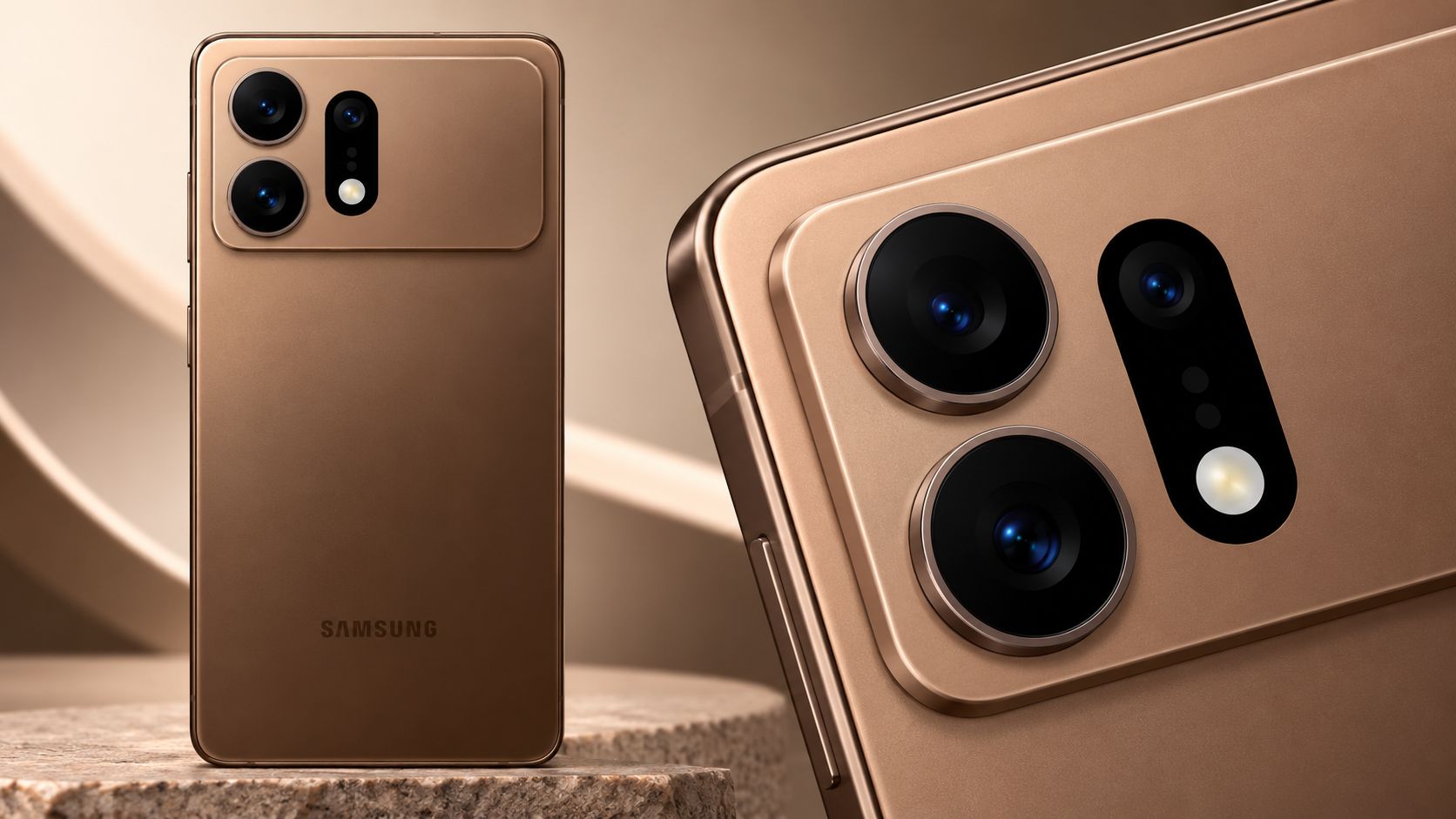
Early supply chain whispers suggested Samsung might pursue an edge-to-edge horizontal visor similar to Google Pixel flagships. However, fresh CAD schematics and intelligence from prominent industry insider Ice Universe confirm that Samsung has abandoned the horizontal visor concept entirely. Instead, the company is preparing a radical visual shift: a raised camera plateau or unified island reminiscent of modern Apple devices and classic Poco camera housings.

This unexpected pivot marks a dramatic chapter in Samsung Mobile eXperience (MX) design history. We examine the technical foundations, structural trade-offs, and ecosystem motivations driving this bold transformation.
The Death of the Floating Lens and Pixel Visor Concept
When Samsung introduced the floating lens architecture, it was hailed as a triumphant masterclass in minimalism. By stripping away massive enclosures, the chassis celebrated pure industrial simplicity. Yet, as sensor technology evolved, physics caught up with aesthetics.
Integrating larger optical formats, heavier periscope glass, and advanced sensor-shift stabilizing elements made standalone cutouts difficult to reinforce. Early prototypes for the Galaxy S27 Ultra flirted with an expansive horizontal visor across the upper frame, an approach praised by enthusiasts for eliminating desk wobble.
According to verified supply chain data, internal testing revealed thermal dissipation and internal volumetric routing conflicts caused by stretching optics horizontally across the motherboard. Samsung MX ultimately scrapped the horizontal bar in favor of an asymmetric elevated camera plateau anchored in the upper corner.
Why Physics and Qi2 Magnetic Charging Forced a Plateau
While subjective aesthetics will always spark passionate online debate, the engineering necessity behind a raised camera housing is rooted in two practical pain points: chassis balance and magnetic accessory clearance.
Eliminating Table Wobble
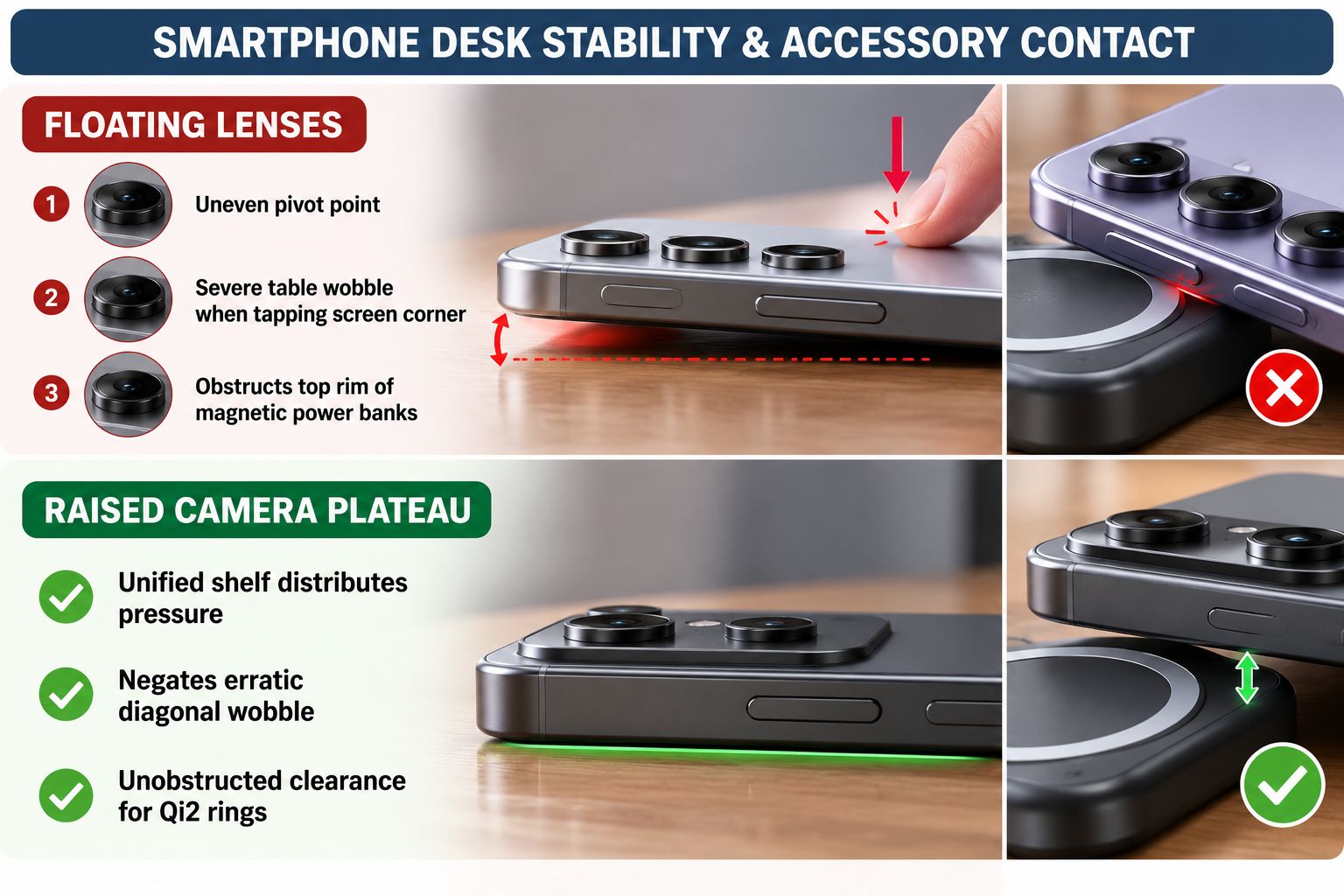
Independent lens barrels create erratic, diagonal pivot points. Tapping the upper left corner of a flat-resting device causes jarring wobble that degrades stylus and typing accuracy. A wide rectangular plateau functions as a planar foundation, distributing downward pressure evenly across the upper edge and dramatically dampening desk rocking.
Unlocking Qi2 Magnetic Wireless Charging
The primary catalyst for this overhaul is the widespread adoption of Qi2 magnetic wireless charging. Samsung’s current flagship layout places vertical camera lenses low enough along the rear spine that magnetic accessory pucks, car mounts, and battery banks collide directly with the lower camera glass.
Enclosing the entire optical array onto a consolidated, elevated island clears essential millimeter-level clearance across the center-rear chassis. This allows a complete 360-degree magnetic ring to seat flush against the rear backplate without awkward case cutouts or tilted charging pads.
Structural Resistance: Hubert H. Lee and the Backlash Factor
Major design overhauls are never without controversy. Ice Universe issued an explicit caution directed at Samsung MX Head of Product Design, Hubert H. Lee, warning the design team to brace for vocal community pushback once the public lays eyes on the final CAD renders.
Samsung built years of visual identity around its uncluttered rear glass. Shifting toward an elevated island will invite inevitable comparisons to the iPhone Pro lineup and select BBK-group designs. Enthusiasts frequently view camera islands as industrial compromises rather than sleek innovations.
Yet design leadership faces an unavoidable reality: packaging thicker optics alongside high-density battery layers requires structural compromise. Housing the sensors inside a two-stage stepped plateau allows the core chassis to remain slim in hand while masking the immense physical depth required by periscope mechanics.
Ultra Exclusivity: Non-Ultra Models Retain the Legacy Look
Crucially, this design disruption will not sweep across the entire Galaxy family. Subsequent CAD leaks reveal that the standard Galaxy S27 and Galaxy S27 Plus (or rumored S27 Pro variant) will retain Samsung’s traditional individual vertical cutouts.
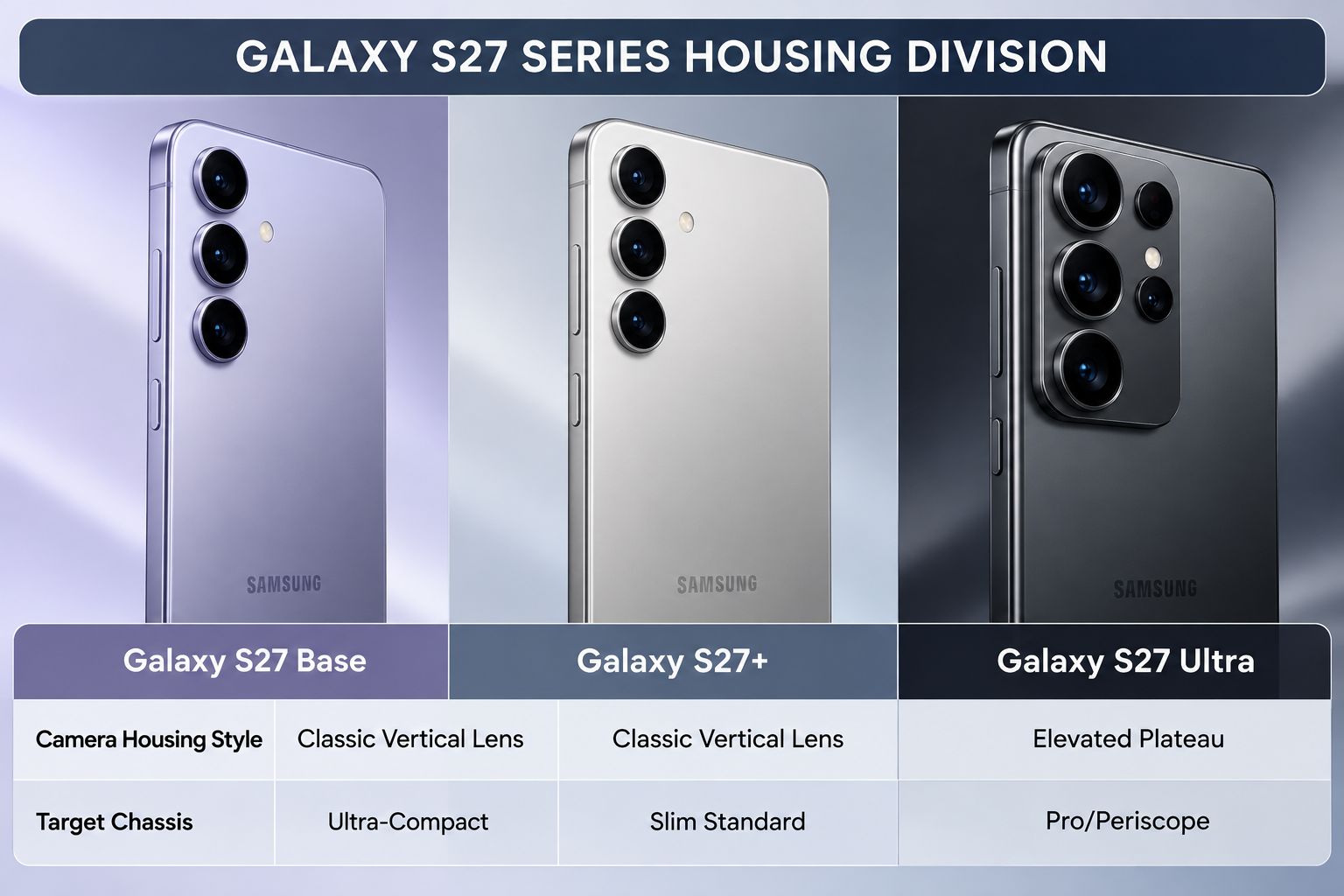
Because the base and plus variants employ more compact optical assemblies without space-demanding periscope prisms, they do not suffer from the same vertical clearance bottlenecks. Confining the elevated camera plateau exclusively to the Ultra model accomplishes two critical objectives:
-
Visual Hierarchy: It immediately signals premium status, ensuring the Ultra looks distinct from entry-tier devices.
-
Targeted Engineering: It preserves the lightweight, pocket-friendly lines of mainstream models while granting the Ultra the physical space needed for flagship optical components.
Inside the Optical Matrix: Sensor Strategy and Periscope Realignment
The physical housing is only half of the equation; internal sensor configurations are undergoing simultaneous realignment. Reports indicate Samsung is refining its flagship quad-camera strategy to prioritize quality over raw lens count.
Consolidating camera glass onto an integrated island enables Samsung to expand the periscope chamber without crowding the internal S Pen silo. The legacy 10MP 3x sensor is expected to be phased out in favor of advanced in-sensor lossless cropping driven by the next-generation 200MP primary sensor, freeing precious cubic millimeters inside the chassis.
The dedicated 5x telephoto module retains its long-range zoom duties, benefiting from improved optical stabilization clearance within the rigid walls of the reinforced camera plateau.
Frequently Asked Questions
Why is Samsung dropping the floating camera design on the Galaxy S27 Ultra?
The change is driven by the physical bulk of larger imaging sensors and the clearance requirements for Qi2 magnetic wireless charging accessories, which previously collided with individual low-hanging lens rings.
Did Samsung consider a horizontal camera bar like the Google Pixel?
Yes, early prototypes explored a horizontal visor across the rear backplate. However, thermal considerations and internal component routing challenges led engineers to scrap it in favor of an asymmetrical camera island.
Who leaked this updated Galaxy S27 Ultra design information?
The detailed CAD schematics and design insights were published by reputable tech insider Ice Universe, who regularly provides accurate early details on Samsung product pipelines.
Will the standard Galaxy S27 and S27 Plus feature the camera plateau?
No. Leaked CAD files indicate the base Galaxy S27 and Galaxy S27 Plus will continue using individual floating lenses, leaving the camera plateau exclusive to the top-tier Ultra.
How does the raised island solve desk wobble issues?
By grouping the lenses onto a wide, flat plateau, the phone rests on a broad horizontal ledge instead of isolated, narrow rings, creating a more stable resting plane that resists tipping.
Does the camera plateau affect S Pen storage?
No. Moving the optical array onto a dedicated external shelf frees up internal volumetric clearance, allowing Samsung to maintain the integrated S Pen silo along the left frame edge.
Will the Galaxy S27 Ultra still feature an S Pen slot?
Yes. CAD schematics confirm that the S Pen remains fully integrated inside the device’s lower chassis, preserving the core utility expected of the Ultra line.
What camera sensors are expected on the Galaxy S27 Ultra?
The device is anticipated to feature an upgraded 200MP primary sensor, an advanced 50MP ultra-wide lens, and a refined 50MP periscope telephoto module with enhanced stabilization.
Why is Ice Universe warning Samsung design leadership about backlash?
Drastic shifts away from established design languages frequently divide brand loyalists. Moving from sleek minimalist cutouts to a pronounced plateau invites direct comparisons to competitors like Apple and Poco.
When will Samsung officially announce the Galaxy S27 Ultra?
Following traditional product cycles, Samsung is expected to unveil the Galaxy S27 lineup at a global Galaxy Unpacked event in early 2027.

Selva Ganesh is a Computer Science Engineer, Android Developer, and Tech Enthusiast. As the Chief Editor of this blog, he brings over 10 years of experience in Android development and professional blogging. He has completed multiple courses under the Google News Initiative, enhancing his expertise in digital journalism and content accuracy. Selva also manages Android Infotech, a globally recognized platform known for its practical, solution-focused articles that help users resolve Android-related issues.





Leave a Reply